For months, most AI search conversations have stayed at the level of prompts, citations, and rankings. A July 1 report from Digiday pushes the discussion somewhere more serious: into web architecture. According to the article, publishers such as Time and The Economist are experimenting with agent-readable versions of content, cleaner machine-facing formats, and stricter rules around which bots can access what.
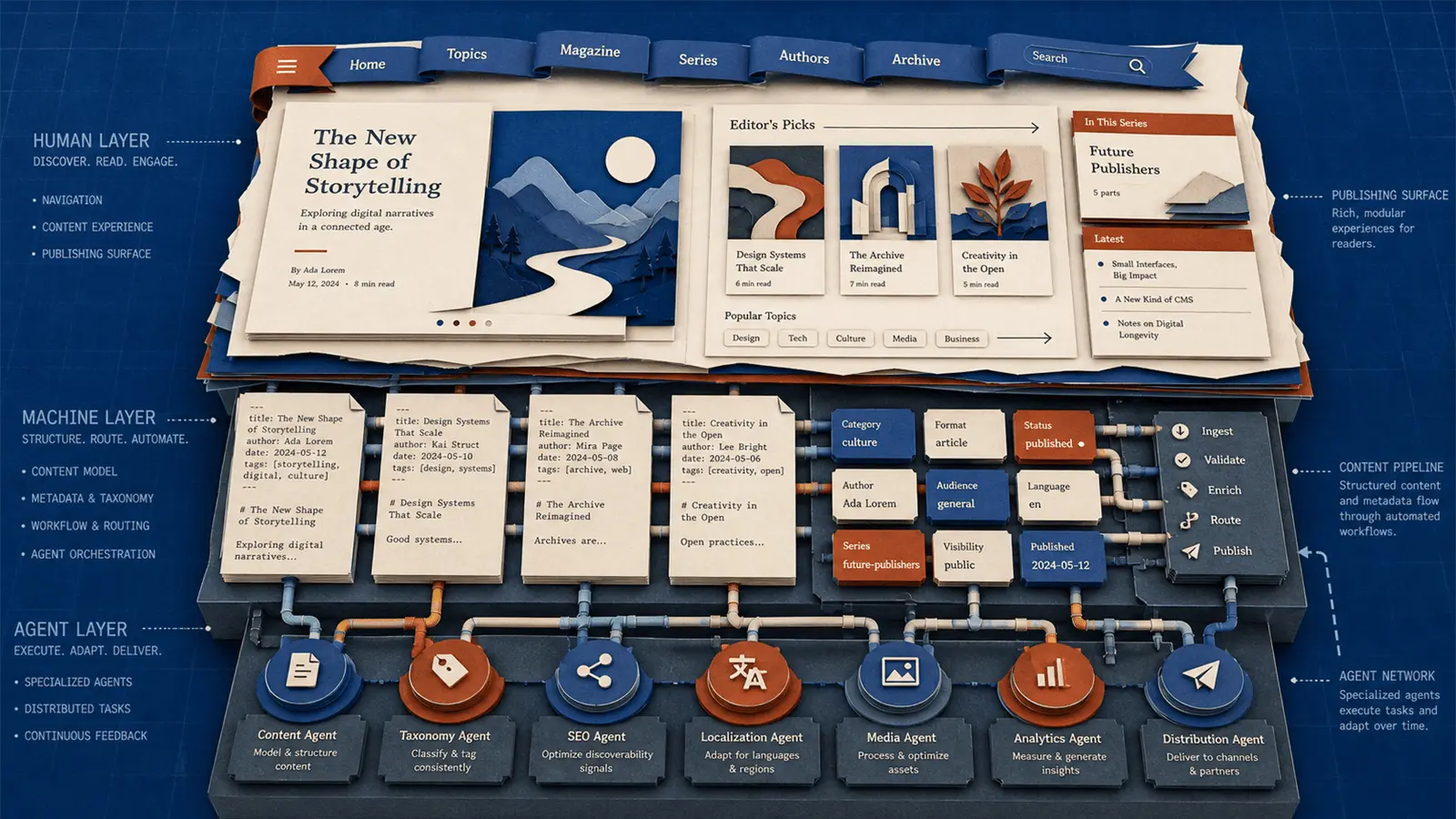
That matters because it suggests the next phase of content strategy is not only about what a brand publishes, but how many surfaces it publishes to. A human page and an AI-readable delivery layer may increasingly be treated as different products, even when they contain the same underlying information.
What changed
Digiday reports that Time is converting pages into simpler formats that AI systems can process more efficiently, while redirecting approved bots to those stripped-down versions. The stated logic is practical: less page bloat, lower processing cost, faster retrieval, and potentially fewer interpretation errors. MarTech made the complementary strategic point on July 2: strong rankings do not automatically create AI visibility, because citation behavior depends on who publishes about your brand and what signals those sources carry.
Taken together, those two pieces point to a clear shift. Content teams are no longer optimizing only for human readers and traditional crawlers. They are starting to think in terms of machine legibility, source authority, and the economics of being read by agents that may not send a click back.
Why this matters for businesses, publishers, and CMOs
Source References
The first implication is organizational. Many teams still assume their website is one surface with one measurement model. That assumption is starting to break. If AI agents increasingly consume structured content directly, then the same article may have one job for a human visitor and another for a machine that decides whether to cite it, summarize it, or ignore it.
The second implication is economic. Cleaner machine-facing delivery may improve citation share and reduce crawl waste, but it can also weaken old traffic assumptions. If more discovery happens in answer layers, then pageviews alone become a less reliable proxy for brand visibility. Leadership teams will need to decide where citation reach is strategically valuable even when the click path gets thinner.
The third implication is editorial. Brands that publish vague, decorative, or overly layered pages make themselves harder to interpret. That was already a usability issue. Now it is also a discoverability issue. If your strongest proof points, product definitions, comparisons, and category language are buried in design-heavy pages, agents may simply find easier sources to cite.
What digital teams should do next
Start by auditing high-value content that should influence consideration, not just attract visits. Category explainers, product comparisons, methodology pages, market definitions, and expert commentary are the best candidates. Ask a blunt question: if an AI system needed to extract the core claim, supporting proof, and brand position in seconds, could it do that cleanly from the current page?
Then separate content architecture from page decoration. This does not mean making the site ugly. It means ensuring the underlying information is modular, explicit, and internally consistent. Headings should answer real questions. Evidence should be named. Definitions should be stable. Key commercial claims should not depend on a designer’s layout flourish to make sense.
CMOs and content leaders should also create a measurement layer for citation influence. Watch not only sessions and engagement, but branded search lift, referral quality, share of authoritative mentions, and whether sales teams hear prospects repeating language that originated in your owned content. If answer engines reshape discovery, some of the clearest impact will show up indirectly.
The management question behind the trend
The deeper issue is ownership. Who in the business owns machine-readable presence? SEO alone is too narrow. Brand alone is too abstract. Engineering alone will optimize for efficiency without deciding which claims deserve strategic prominence. The winning setup is usually cross-functional: editorial, SEO, product marketing, analytics, and web operations working from the same source-of-truth logic.
The agent-ready web is not a publishing curiosity. It is a signal that content is becoming infrastructure. The brands that adapt early will not just chase citations. They will design their knowledge layer deliberately, so both humans and machines can understand what the company stands for and why it should be recommended.
- Digiday: How Time and others are rebuilding parts of the web for AI agents
- MarTech: AI visibility depends on who writes about your brand