A martech stack can be expensive even when the license price looks reasonable. The hidden cost is the time people spend making tools talk to each other by hand.
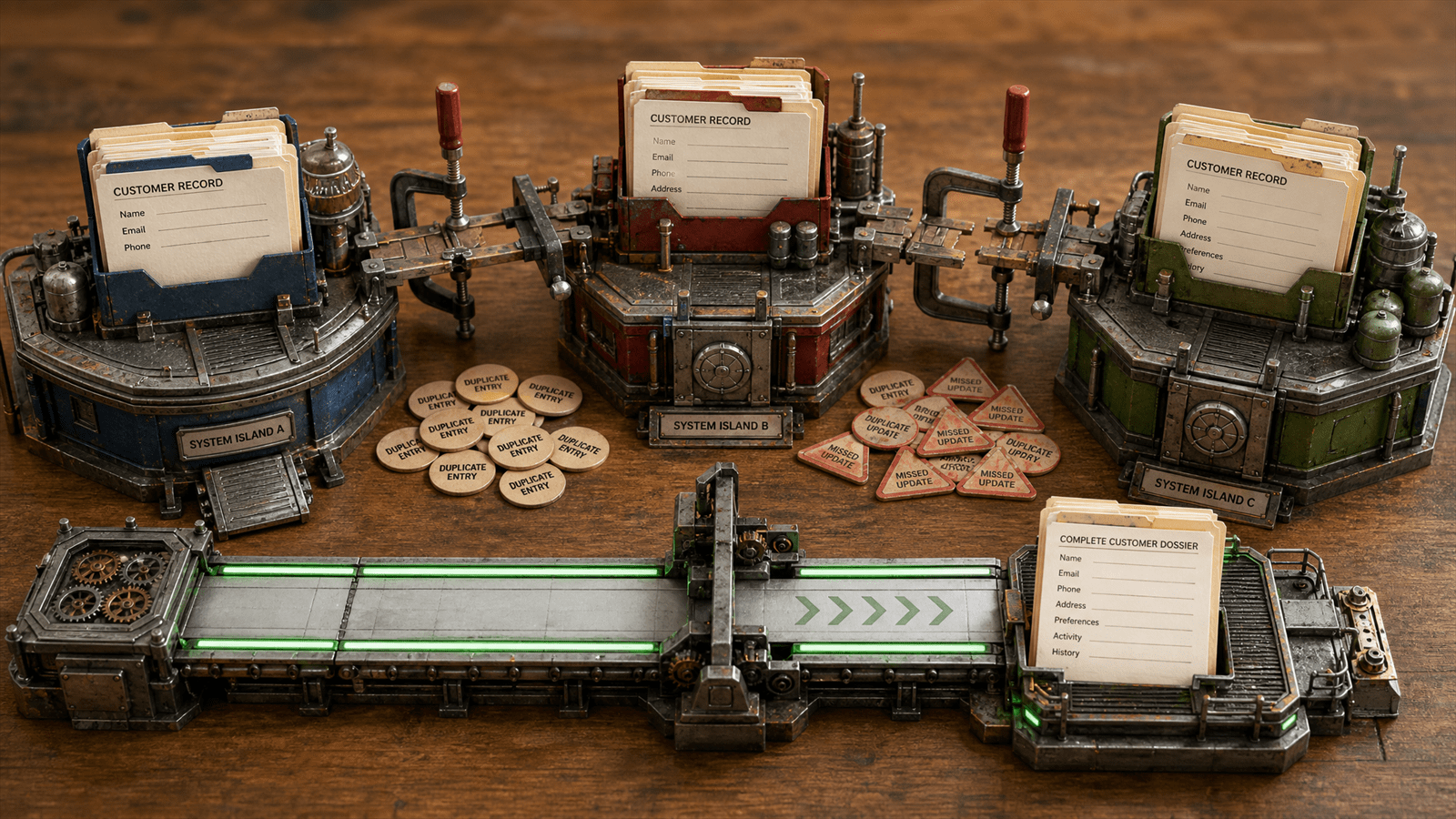
MarTech reported on August 14 that Pipedrive’s 2026 CRM trends report, based on 1,000 sales and marketing professionals, found that nearly three-quarters of respondents need at least two systems to get a complete customer account view. The same article says 62% report missed actions, opportunities or updates at least once a week because tools are disconnected.
The hidden cost is between tools
Most software evaluations ask what a tool can do. Fewer ask what happens between tools. That is where productivity often disappears: a campaign manager checks one system for a segment, a CRM owner updates another record, a sales person logs an activity elsewhere and someone later reconciles what changed.
Each application may perform its job. The stack still fails if customer context breaks whenever work crosses a boundary. The result is not only frustration. It is slower follow-up, missed handoffs, weaker personalization and reporting that depends on manual cleanup.
Employees become the integration layer
MarTech’s summary highlights a useful way to describe the problem: people end up doing the work the stack does not. They move between applications, carry context, enter the same information twice and remember which system must be updated next.
More than half of respondents in the cited report spend at least six hours per week on manual data entry, system updates and administrative tasks. That time is part of the technology cost even if it never appears in the vendor invoice.
A practical martech productivity audit
- Pick one common customer decision, such as lead qualification, nurture entry, renewal risk or campaign suppression.
- List every system a person must open to make that decision confidently.
- Count duplicate data entry, manual exports, copy-paste steps and fields that must be checked in more than one place.
- Record missed-update points: where does the next action fail if one human forgets?
- Estimate weekly admin hours by role, not only by department.
- Rank fixes by work removed, not by how impressive the automation sounds.
What to automate and what to remove
Automation helps when it removes a real handoff. It is weaker when it simply sends more tasks into the same fragmented system. Before buying another tool or AI feature, ask whether the change eliminates duplicate entry, carries context automatically or removes a system from the workflow.
Sometimes the best martech decision is subtraction. If a tool only creates another place to check without changing a decision, it may be adding reporting surface rather than operating value.
The CMO takeaway
Martech productivity should be measured by the work that disappears. A stack is not better because it has more capabilities. It is better when a customer record, a next action and a performance signal move through the organization without people acting as the integration layer.
Before the next purchase, run the admin-cost audit. The answer may be a new integration, a workflow rule, a data cleanup project or one less tool.