Google’s new YouTube creative guidance gives media teams a useful warning: weak assets can waste budget before the bidding system has a chance to help. The document cites Nielsen research that creative accounts for 49% of campaign ROI and Ekimetrics analysis that improving creative can more than double ROI on YouTube. Those numbers should not be turned into a promise. They should be turned into a QA process.
Too many YouTube plans move from audience to bid strategy to budget without stopping at the asset itself. If the first seconds do not make the brand and offer clear, if the image looks like a recycled banner, or if fake buttons compete with YouTube’s own interface, the campaign is asking the auction to solve a creative problem.
What Google added to the conversation
The fresh guidance is practical because it names observable creative signals. For Demand Gen in-stream skippable ads, Google says including a human voice drove 12% higher conversions on average in the U.S. in July 2026. Supers or text overlay drove 3% higher conversions on average, and showing the brand in the first five seconds drove 4% higher conversions on average.
Those are averages, not universal laws. A software demo, a fashion launch and a local-services offer will not need the same execution. But the direction is clear: YouTube creative has to fit the user interface, the viewing context and the moment when attention is still available.
The five-point YouTube creative checklist
First, score the opening five seconds. Can a viewer identify the brand, product category and reason to keep watching without sound or prior knowledge? Second, check the voice. If a human voice can explain, demonstrate or add trust, use it deliberately rather than treating audio as background decoration.
Third, review text overlays. They should clarify the value proposition, product step or proof point; they should not simply repeat a slogan. Fourth, inspect images for fake UI. Google specifically warns against baked-in buttons, arrows or clickable-looking overlays because they create confusion against YouTube’s standard calls to action. Fifth, test whether the asset feels native to YouTube feeds: full-bleed, high-resolution imagery usually works harder than empty bars, oversized logos or cramped banner layouts.
How to score existing assets before scaling
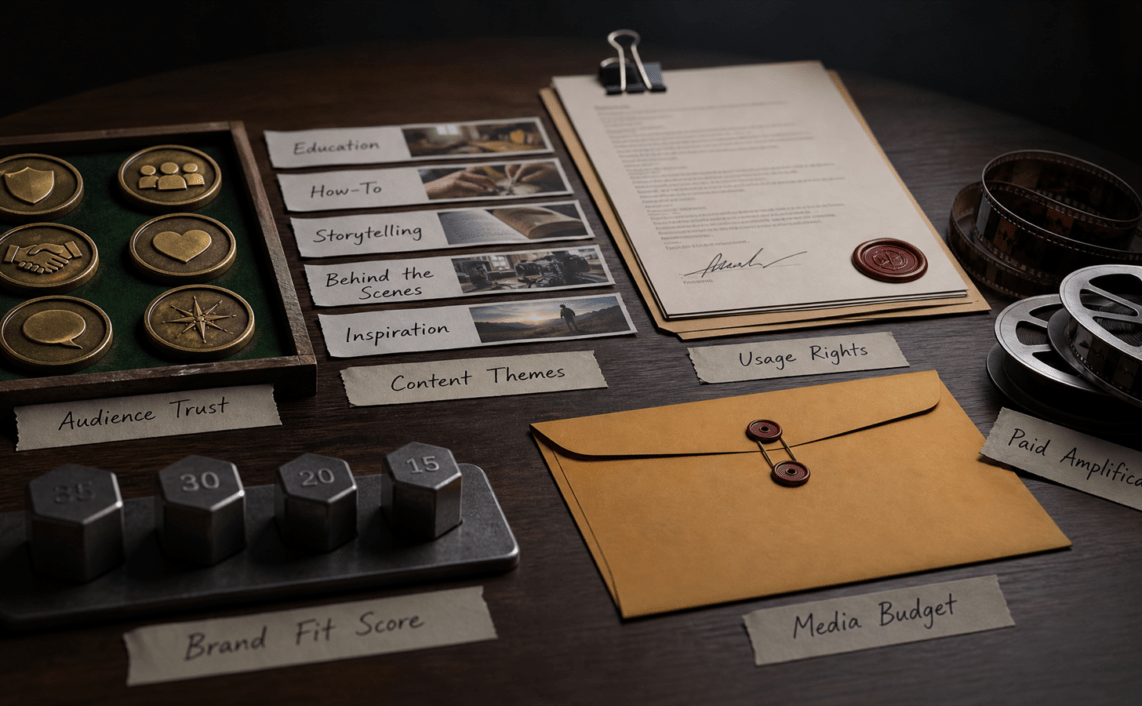
Create a simple traffic-light review for every video and image asset: pass, fix, or retire. Pass means the asset shows the product or use case early, reads on mobile, has useful audio or captions, and does not fight the platform interface. Fix means the core idea is strong but the edit, crop, supers or opening sequence need work. Retire means the asset was built for another channel and cannot be rescued without remaking it.
This scoring should happen before budget increases. A campaign with weak creative may still spend efficiently in a narrow remarketing pool, then fail when it scales. The checklist gives paid-media and creative teams a shared language for that failure.
What to test next
Do not test everything at once. For one flight, compare early brand cue versus delayed reveal. For another, compare voiceover versus music-led creative. For ecommerce, test demonstration-first images against polished product-only images. For B2B, test a problem statement in the first three seconds against a brand-led opener.
Keep the measurement honest. The creative test should have enough volume, comparable audiences and a clear success metric. If the business needs leads, do not optimize only for views. If the business needs qualified demand, connect the test to later funnel signals where possible.
The budget decision
The practical lesson for CMOs is that creative quality is now a media control, not a finishing touch. Before raising spend, ask whether the campaign has assets that deserve more delivery. If the answer is unclear, buy learning first: produce fewer, sharper variants, score them against YouTube’s viewing context, and scale the creative that earns the next budget step.