Google AI Mode can now show a sponsored option after a follow-up question, rather than only at the start of a search conversation. For an advertiser, the immediate decision is whether existing campaigns cover the new buying context. A new placement is not, by itself, a reason to create another campaign or budget line.
On November 9, Barry Schwartz published first-hand screenshots and video of ads appearing in follow-up responses. Google had announced US multiturn ads on October 28. Keep those two facts separate: the announcement describes the product direction; the observation shows an instance of it in use, not universal access or a performance result.
Existing campaigns can participate
Google’s current help documentation says advertisers do not need new campaigns or separate budgets for ads in AI Overviews and AI Mode. It identifies Search, Shopping and Performance Max as eligible campaign types. Eligibility still operates through the auction when relevant; it does not promise that every advertiser or every follow-up question will receive an impression.
The multiturn announcement concerns the US. Do not assume that a Ukrainian or French campaign receives the same placement because the article is available in those languages. Confirm the market and the capabilities relevant to the account before changing a plan. Campaign eligibility and an observed placement are different pieces of evidence.
Audit the buying situation behind the follow-up
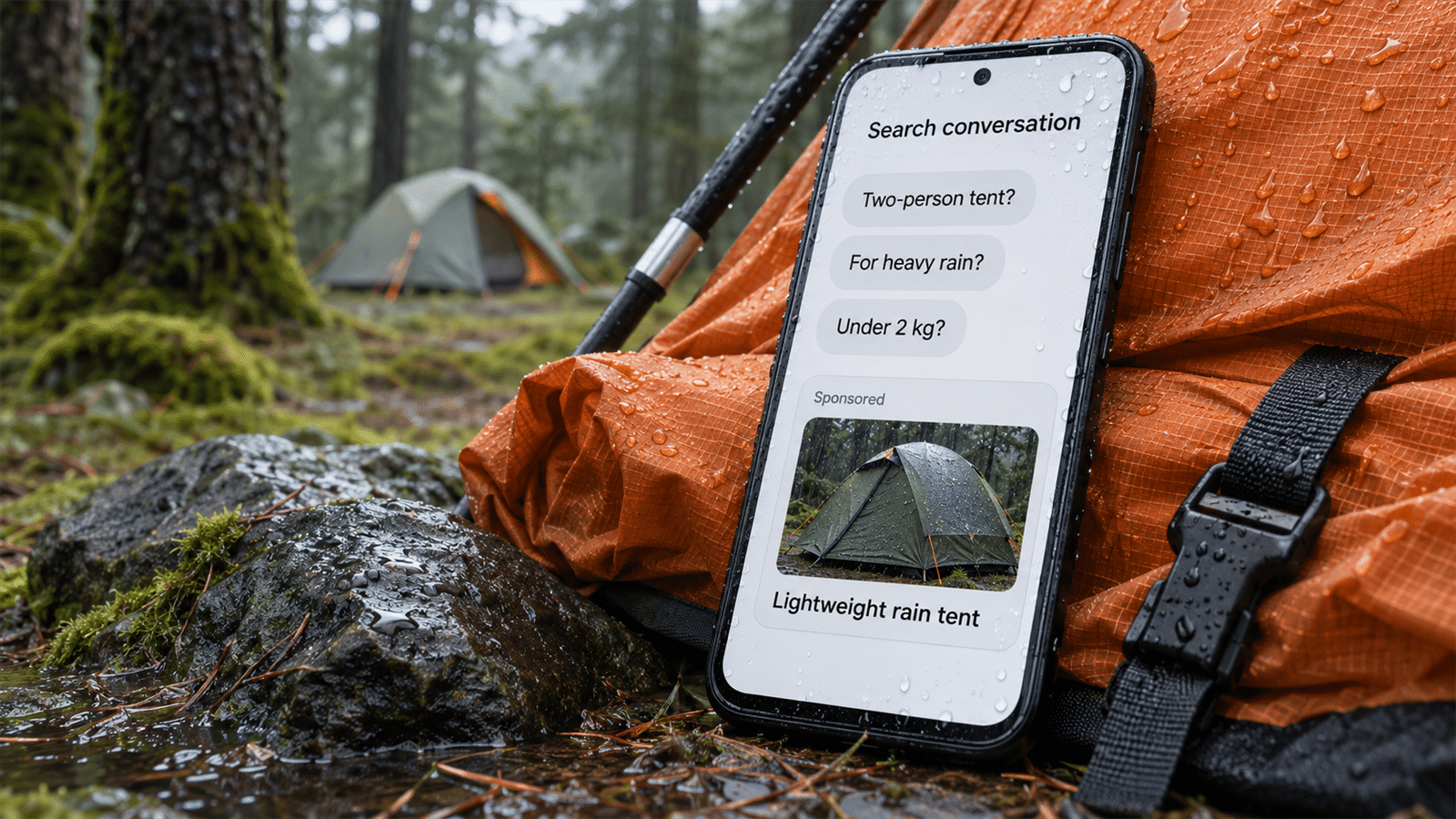
Our suggested review begins with one product category and a few realistic sequences of questions. A shopper might start with a two-person tent, then add heavy rain and a weight limit. This is an illustrative example, not a reported Google query. The useful test is whether the ad destination can substantiate the later requirements without making the visitor restart the search.
For each sequence, record the buyer’s constraint, the relevant product or service, the campaign expected to cover it and the landing page’s evidence. Verify specifications, availability and conditions against the actual offer. If the destination cannot answer a commercially important question, fixing that gap is more concrete than writing a generic claim about being ready for AI.
Keep the measurement claim narrower than the rollout
Google says performance from these AI experiences is included in aggregate in standard campaign reporting. A change in the campaign total is therefore not a clean experiment measuring follow-up ads alone. Do not label an ordinary before-and-after ROAS comparison as the return from multiturn inventory unless the evidence actually isolates that effect.
Keep a dated record of what changed in the account, offer and landing pages. Review qualified enquiries or completed sales alongside cost, rather than celebrating the appearance of an ad. Where a controlled comparison is feasible, define it before intervention; otherwise describe the result as an observation with competing explanations.
Use a coverage decision before a spending decision
A compact decision rule is useful. If the market or account capability is unconfirmed, document the uncertainty. If relevant existing campaigns participate but the destination lacks necessary product evidence, repair the offer presentation. If coverage is sound, evaluate commercial results before increasing the campaign’s allocation.
No separate budget requirement does not mean the distribution of existing spend will remain unchanged. The management task is to understand what the current budget can reach and whether the resulting visits serve the business. Treat follow-up ads as another buying context to validate, with the same discipline applied to any acquisition channel.
Sources
- Google AI Mode Multiturn Ads — first-hand observation
- Ads in AI Mode expand to new markets — Google
- About ads in AI-powered experiences in Google Search — Google Ads Help