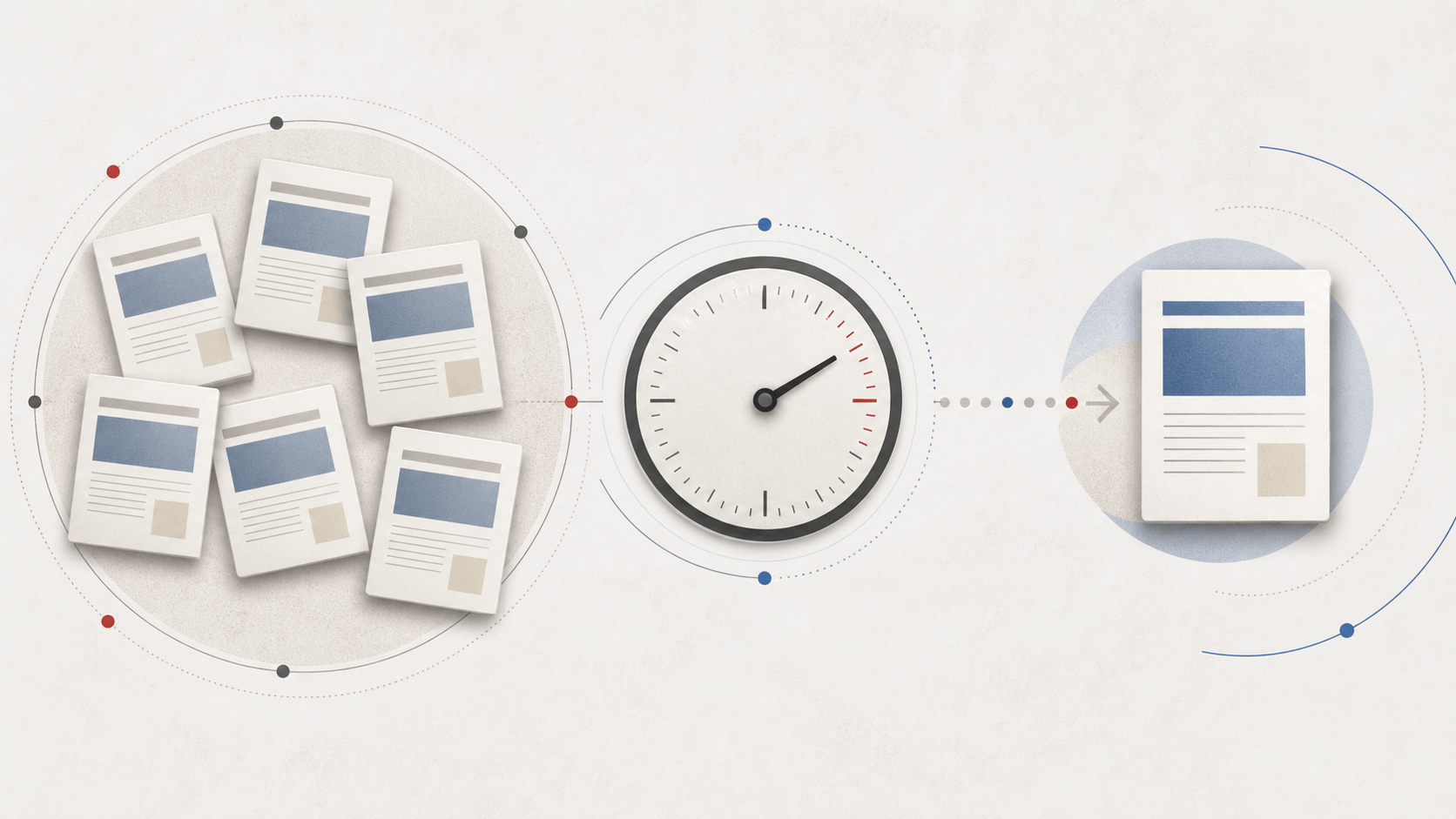
Technical SEO teams are often measured on how quickly they react to problems. That creates a bad habit: when Google still shows an undesired canonical after a fix goes live, the team assumes the repair failed and starts changing templates, links or rules again. A July 10 report from Search Engine Land highlighted why that reflex can be counterproductive. Google updated its canonicalization troubleshooting guidance to say that after content issues are fixed, pages may remain in a duplicate cluster for up to two weeks while re-evaluation happens.
The number matters, but the workflow lesson matters more. The update is not really a story about patience for its own sake. It is a story about diagnosis discipline. Teams often create extra noise by piling new changes onto a canonical issue before Google has had enough time to process the original correction. When that happens, the audit trail gets muddy, development effort is wasted and nobody can tell which change actually mattered.
Why impatient SEO workflows make canonical problems harder to diagnose
Canonicalization issues feel deceptively simple. A page should be the representative URL, but Google is still clustering it with other versions or selecting the wrong variant. Because the symptom is visible in tools, the pressure to react is immediate. The problem is that visible symptoms do not always mean the system has finished re-evaluating the fix.
That gap between implementation and reprocessing is where many teams overcorrect. A developer adjusts canonicals. An SEO lead changes internal links. Another person rewrites snippets of copy to increase differentiation. Someone else pushes sitemap updates. None of those actions is inherently wrong. But when they are stacked too quickly, the team loses a clean read on whether the first fix was already sufficient. What looked like urgency becomes a measurement problem.
Google’s updated guidance provides a more useful expectation. According to the canonicalization troubleshooting documentation, re-evaluation takes time and pages may stay in a duplicate cluster for up to two weeks after content issues are fixed. The same guidance also says pages generally split faster when the difference between them is clear and significant. That means canonical work is not only about tags and signals. It is also about how unmistakably distinct the competing pages actually are.
What Google’s two-week clarification actually changes
The clarification should change how teams decide whether a fix failed. It does not mean every canonical problem disappears if you wait 14 days. Weak or conflicting signals can still keep the wrong page in place longer. But it does mean that “still clustered after three days” is no longer a strong reason to panic by itself. The appropriate next step may be observation, not another deployment.
This matters especially for teams working across CMS templates, faceted navigation, syndication, international variants or campaign landing pages. In those environments, one canonical problem often sits inside a larger network of duplicate or near-duplicate URLs. Repeated edits without a validation window can multiply the confusion. Google’s documentation is effectively giving technical SEO teams a more realistic service-level expectation for their own monitoring routines.
The update also reinforces another important point from Search Central: canonicalization should be signaled consistently. Google explicitly notes that robots.txt is not a canonicalization tool, that redirects and the rel=”canonical” signal should align with your intended representative URL and that sitemap canonicals should support the same preference. When teams reach for mixed workarounds under time pressure, they often create signal conflict instead of resolution.
How to build a calmer post-fix validation routine
The practical response is to design a post-fix observation window before the next escalation happens. That window should include a record of the exact changes pushed, the URLs involved, the intended canonical target, the content differences that support the choice and the date from which the team starts monitoring. If Google still selects the wrong cluster after a fair waiting period, the diagnosis can become more specific. Before that point, more changes may only reduce clarity.
It also helps to separate content problems from signal problems. If two pages are still too similar in substance, a technically correct canonical tag may not solve the business issue cleanly. The documentation’s note that clearer content differences can speed split-out is useful because it reminds teams that deduplication is partly an information-design problem. Canonical tags are not magic labels that excuse fuzzy page strategy.
The broader takeaway is that technical SEO maturity is not only the ability to fix things quickly. It is the ability to know when not to touch the same issue again yet. Google’s clarification gives teams permission to stop mistaking latency for failure. In a search environment full of reactive dashboards and instant alerts, that may be more valuable than the headline itself.
Source References
- Search Engine Land: Google clarifies canonicalization fixes can take up to two weeks to resolve
- Google Search Central: Fix Canonicalization Issues