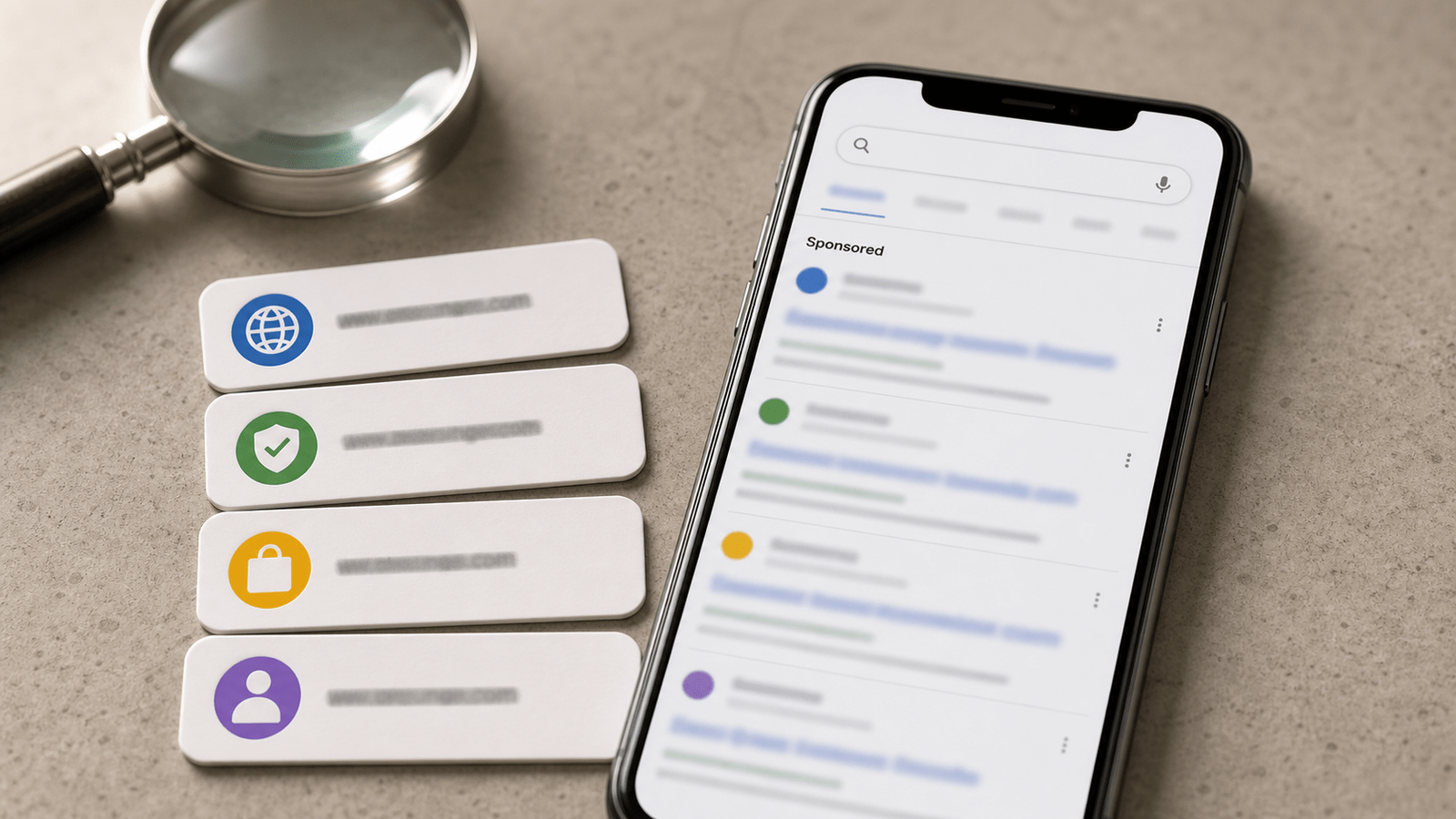
Google is testing a mobile Search ad layout that shows a list of participating advertisers before the individual sponsored results. Search Engine Land reported the experiment on August 11, noting that the list can show favicon-style identity cues and domain names above the ad block. Google has not confirmed a rollout, so this is not a migration plan. But it is enough for paid search teams to ask a practical question: what happens when users evaluate the advertiser before they read the ad?
For years, PPC managers have treated business names, logos and favicons as secondary presentation details. The budget work sat in bids, match types, creative testing and landing pages. A format like this changes the scanning sequence. If the first thing a mobile user sees is a compact list of advertisers, brand recognition becomes part of the paid search decision path.
What changed
The reported test places advertiser identities above the sponsored results block on mobile Search. Instead of moving directly from the Sponsored label into ad copy, the user may see which companies are present first. That does not remove the importance of copy, offer and landing-page relevance. It adds an earlier filter: do I recognize or trust any of these names?
That matters most on competitive non-brand queries. A challenger with better copy may still lose attention if the identity row makes a larger competitor easier to notice. A strong brand, meanwhile, may gain more from presence than from another small wording change in the description line.
Why identity now affects paid search
Google’s own business information documentation already treats business names and logos as controlled assets that must align with verified advertiser information. That makes them operational assets, not decoration. If a mobile format gives those assets more visibility, the PPC team needs to manage them with the same discipline it applies to extensions, feeds and landing pages.
The first risk is inconsistency. Different legal entities, sub-brands, marketplaces and franchise domains can create confusing identity signals. The second risk is weak recognition. If the favicon is generic or the domain does not match how customers know the brand, the account may technically serve ads while failing the first scan.
A mobile SERP checklist
- Review business name and logo assets for every active account and important sub-brand.
- Check favicons, site names and verified domains on mobile, not only desktop.
- Compare brand and non-brand queries where recognition could change click distribution.
- Inspect competitors that appear beside you; the identity row may make the competitive set more visible.
- Separate CTR movement from conversion quality. A recognizable name can raise clicks without improving customer fit.
This checklist is small enough to run before a budget review. The goal is not to chase a test screenshot. It is to ensure the account is ready if identity becomes more prominent in mobile paid search.
How to measure the test
Do not judge the effect by blended account CTR. Segment mobile Search, query type, brand familiarity and top markets. Watch impression share, click-through rate, conversion rate and assisted brand search. If unknown competitors start appearing more visibly, review auction insights alongside creative and landing-page changes.
For ecommerce and lead generation, add a simple customer-quality check. If the identity row attracts more comparison clicks, the landing page must quickly prove why the brand deserves the visit. If it attracts more loyal clicks, budget may shift toward defensive coverage.
The CMO takeaway
The test is another reminder that paid search is not only a keyword auction. It is also a trust interface. When Google changes how advertisers are presented, the work moves beyond bid management into brand systems, verification hygiene and mobile SERP evidence.
For today, do not rebuild the account around a limited experiment. Audit the identity layer, save mobile examples, and decide which queries would be most exposed if advertiser recognition appears before copy. That is a useful paid search control even if the test never becomes the default layout.