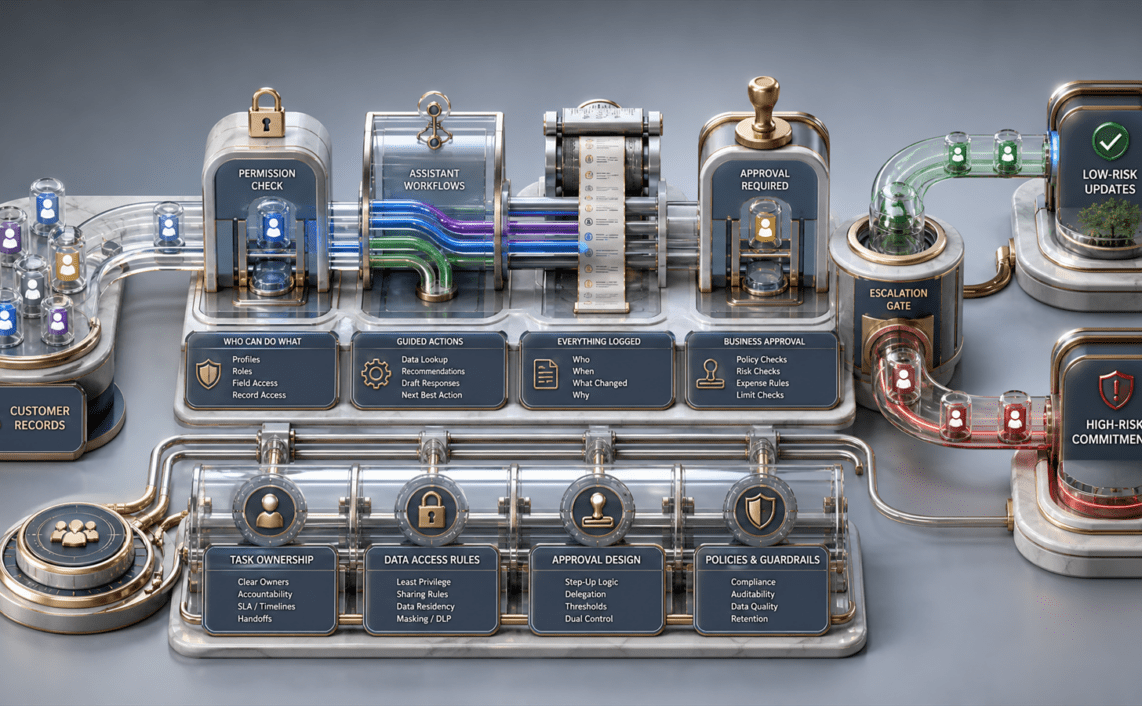
There is a growing gap inside customer experience strategy. Companies are investing in AI faster than ever, yet many are still acting as if the main question is whether they should launch a branded chatbot. Two fresh July 10 signals suggest that is already the wrong frame. MarTech reports that 90% of CX organizations are piloting or deploying AI. On the same day, CX Dive reported Gartner data showing customers are three times more likely to use a third-party generative AI tool than a brand-owned chatbot for customer service.
Taken together, those numbers point to a more uncomfortable reality. AI in service is clearly maturing. But the branded bot is not necessarily the surface where customers want that intelligence to show up. Many organizations are racing to automate, govern and instrument service operations while customers increasingly start their help journey somewhere else: in a general assistant they already trust, use frequently and can ask in plain language without entering a company’s own experience first.
Why AI adoption in service is racing ahead of customer trust
The MarTech coverage is useful because it shows where AI adoption is actually landing. The most common use cases are not cinematic front-end experiences. They are operational improvements: self-service automation, automated quality assurance, speech and text analytics, compliance monitoring and agent assistance. That tells us something important. Companies are finding value where AI can make existing service systems faster, more consistent and more manageable.
But the same article also shows why the work is harder than a launch announcement makes it sound. Data security is the top implementation concern. Reliability, scalability and customer consent are all near the top as well. In other words, trust is not a marketing afterthought here. It is part of the architecture. If a service experience is fast but opaque, or personalized but badly governed, adoption will stall or customers will simply bypass it.
That is exactly where the CX Dive result becomes strategically important. If customers are already more likely to use third-party AI tools than brand chatbots, then the problem is not merely interface design. It is confidence. People appear willing to ask an assistant for help when it feels familiar, broad and flexible. Brand-owned bots, by contrast, are often experienced as narrow, defensive or too obviously optimized around company workflow rather than customer outcome.
The real mismatch is between where brands build and where customers ask for help
Many service strategies still assume the brand owns the start of the conversation. That assumption is weakening. A customer may now begin with a general AI assistant, ask which policy applies, summarize a problem, compare options or prepare the right wording before ever visiting the company’s own channel. If the brand is building AI only as an on-site or in-app bot, it may be optimizing the wrong surface.
This does not mean owned service interfaces no longer matter. They do. But their job changes. Instead of behaving like the singular AI destination, they need to function as part of a wider service system that can absorb intent from multiple entry points, hand off cleanly, honor consent and provide trustworthy resolution. In that system, the advantage is not “we have a bot.” The advantage is “our service logic still works when the journey begins elsewhere.”
That is also why governance becomes commercially relevant. MarTech notes that organizations are split across end-to-end, hybrid and best-of-breed architectures. No dominant model has won. Flexibility appears to be the strategy. That makes sense. If the customer journey is no longer guaranteed to begin in one branded interface, rigid AI architecture becomes a liability. Teams need routing, policy and measurement that can travel across channels and tool surfaces.
How to design AI service systems that work beyond the chatbot launch
The first practical shift is to stop measuring success by chatbot existence. Existence is not adoption, and adoption is not resolution. Teams should ask which problems customers actually trust AI to handle, which ones need fast human handoff and which ones are likely to start in a third-party assistant. That immediately changes roadmap priorities. Knowledge quality, escalation logic and policy clarity become more important than the bot persona or welcome script.
The second shift is to treat consent and reliability as product value, not merely legal hygiene. A service AI that is honest about limits, hands over gracefully and uses data predictably will outperform a more “intelligent” experience that feels slippery or overreaching. This matters for marketers too, because brand trust is shaped by service interactions as much as by campaigns.
The third shift is organizational. Service AI should not be owned only by one digital-experience team chasing a shiny front-end launch. It needs coordination across operations, policy, support, martech and analytics. The MarTech findings suggest that much of the ROI is already coming from better internal support, exception handling and decision assistance. That means companies should design AI service as an operating model first and a branded interface second.
The lesson from these two July 10 pieces is not that brand chatbots are finished. It is that many companies are still mistaking the wrapper for the system. Customer-service AI becomes strategically useful when the brand can deliver trustworthy resolution across multiple entry points, including ones it does not fully control. Teams that understand that will build better service, not just more visible bots.
Source References
- MarTech: AI adoption hits 90% as CX deployment paths diverge
- CX Dive: In customer service, third-party generative AI tools are beating brand chatbots