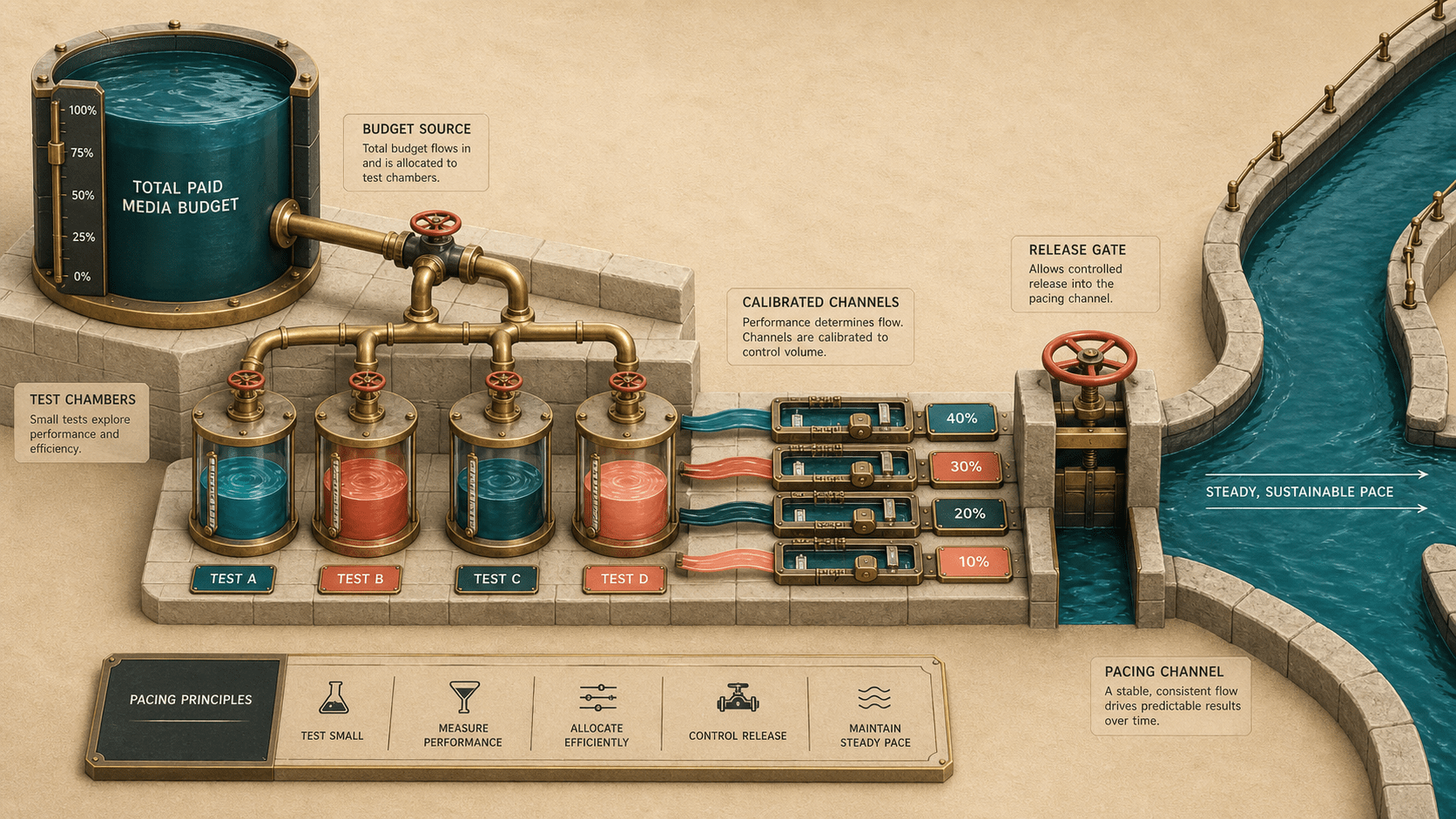
Many media teams still treat a launch budget as a confidence statement. If leadership wants growth fast, the instinct is to approve the biggest spend level the account can tolerate and then ask the channel to prove itself quickly. That logic feels decisive. In practice, it often wastes money. A July 10 article in Search Engine Land makes the core point clearly: most campaigns do not get stronger because you flood them with budget on day one. They get noisier.
The reason is simple. Early campaign performance is usually the least trustworthy performance the system will produce. Audiences are still being tested. Creative fit is still unclear. Bidding systems are still learning. Landing-page friction has not been fully exposed yet. If you frontload spend before those signals stabilize, you are not scaling strength. You are scaling uncertainty.
Why bigger launch budgets often create weaker learning
There is a persistent misunderstanding inside performance marketing that speed and aggression are the same thing. They are not. A campaign can move quickly while still being staged intelligently. Search Engine Land argues that frontloading budget often raises acquisition costs, slows optimization and weakens stakeholder confidence when the early numbers disappoint. That framing matters because the damage is not only financial. It is epistemic. Teams lose the chance to understand what is really working.
Large launch budgets create pressure to read too much into immature data. A few early conversions can look like proof. A few weak signals can look like failure. Neither interpretation is reliable when the account has not had time to settle. Algorithms need enough room to test bidding and delivery patterns. Humans need enough room to compare segments, messages and intent states without confusing randomness with repeatability.
This is why the old Jim Collins idea of firing bullets before cannonballs still works for media teams. A smaller calibrated test is not an act of caution for its own sake. It is a way to buy cleaner information. That information becomes the justification for the next spend release. Without it, the budget ramp turns into hope wearing a spreadsheet.
The real job is not to spend fast but to scale signal
The most useful way to read this advice is operational, not philosophical. Budget pacing is a system design problem. The question is not whether the team believes in the campaign. The question is what level of spend the system can absorb without corrupting the learning process. If the spend level outruns the clarity of the signal, the team gets false positives, false negatives and higher costs all at once.
That is especially relevant now because pressure on marketing leaders comes from both directions. Commercial teams want faster growth. Finance teams want more predictable efficiency. Launch pacing is where those tensions usually surface first. A rushed ramp can make marketing look decisive for a week and unconvincing for a quarter. A staged ramp, by contrast, gives teams a defendable logic for each next move: here is what we tested, here is what improved, and here is why the next budget increase is justified.
Seen this way, pacing is not the opposite of ambition. It is how ambition becomes governable. When a team says it wants to double spend, the serious follow-up question is not whether the budget exists. It is whether the account has earned the right to spend it efficiently.
How teams should define the ramp before the campaign goes live
The practical discipline should begin before launch, not after the first week of panic. Teams need a ramp plan with explicit gates. What performance threshold would justify the first increase? Which audience or creative variables must be validated before a second increase? What failure signals would pause the ramp? Those answers create operating clarity for both marketers and finance partners.
That also changes the conversation with executives. Instead of promising that a large launch budget will create fast certainty, performance leaders can explain that certainty is produced through staged learning. This often lands better with CFOs and founders than media jargon does, because it frames spend as a sequence of controlled investments rather than a dramatic bet.
There are exceptions. Mature accounts with strong historical data, predictable seasonal demand or repeated campaign structures can scale faster. Search Engine Land is right to note that the most rigid version of the rule would be simplistic. But the exception only proves the principle: aggressive scale works best when prior information is unusually strong. Most campaigns do not start there.
The broader lesson is that paid media does not become smarter because money enters the system earlier. It becomes smarter when the system can distinguish between noise and repeatable performance. Marketers who understand that will stop using launch budgets as theater and start treating pacing as one of the most important parts of performance design.