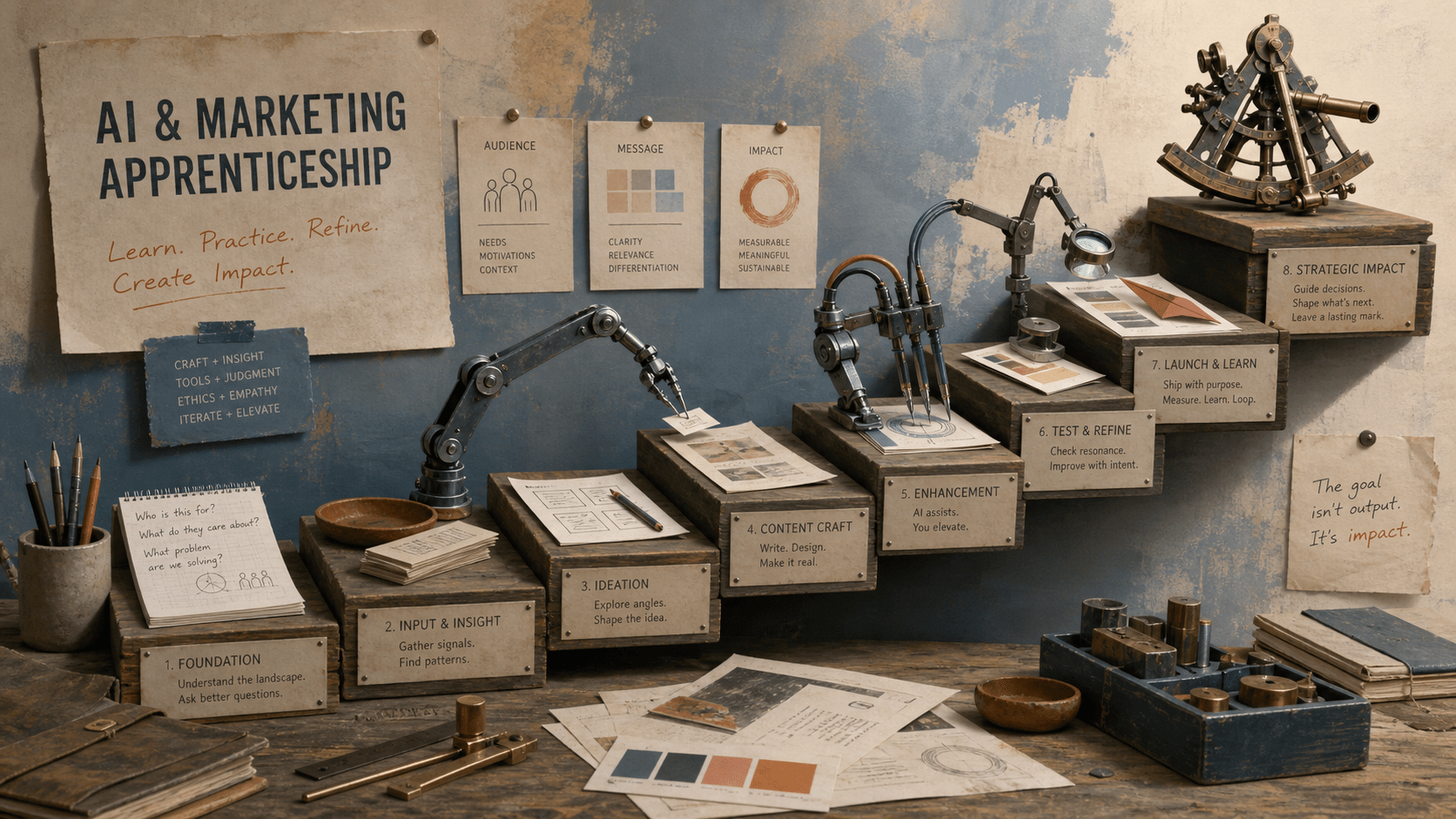
Most conversations about AI and marketing jobs still stay on the wrong question: will the tools replace junior marketers? The more urgent question is harder and more operational. If AI systems take over the low-level execution work that junior marketers once used to learn the craft, where will future marketing leaders build judgment?
A July 10 MarTech article makes that concern explicit. Marketing has traditionally worked as an apprenticeship. People do not become strong strategists because they read decks about strategy. They become stronger by building campaigns, seeing where execution breaks, receiving feedback and slowly learning what good looks like. Remove too much of that early learning surface and the leadership pipeline can weaken long before anyone notices.
Why AI can remove the ladder before leaders notice
The problem is easy to underestimate because automation often arrives as a productivity win. A junior marketer can use AI to draft copy faster, cluster keywords faster, summarize research faster or assemble a campaign outline faster. None of that is inherently bad. In fact, some of it is clearly useful. But when the system hides the work that teaches judgment, the organization can lose something important while believing it has only gained speed.
MarTech describes the issue well: marketing talent develops through doing, mistakes and feedback. That matters because many foundational tasks are not valuable only for their output. They are valuable because they expose the logic behind good decisions. Writing weak copy teaches why claims fail. Building audience tests teaches what segmentation actually means. Reviewing a messy spreadsheet teaches why definitions and hygiene matter. If AI turns those moments into black-box convenience, juniors may complete more work while understanding less of it.
NACE’s latest labor-market data adds a useful second signal. In April, the organization reported that demand for AI skills in entry-level jobs nearly tripled since fall 2025 and that more than one-third of entry-level roles now require AI skills. Nearly 60% of employers also say they assign interns projects that use AI tools. That means the transition is not theoretical. Teams are already redesigning early-career work around AI. The unresolved question is whether they are redesigning learning with the same seriousness.
The real risk is not automation but unmanaged judgment transfer
This is where many AI adoption plans are still too shallow. They focus on output compression: fewer hours, faster drafts, more throughput, lower execution cost. Those gains are real, but they are incomplete if nobody asks how judgment is supposed to transfer inside the new workflow. A faster system that produces weaker operators is not actually efficient. It is borrowing from the future.
The leaders who will manage this transition best are the ones who stop treating junior work as a pile of removable tasks and start treating it as a training environment. Some repetitive work should disappear. That is not the problem. The problem appears when organizations remove the repetition but fail to create new spaces where diagnosis, critique, tradeoff thinking and commercial reasoning are taught deliberately.
That is especially important for agencies and in-house teams that want AI to flatten headcount pressure. If the junior layer gets thinner while the senior layer still expects the same bench quality in two or three years, the organization can run into a capability shock. It may have more content, more automations and more dashboards, but fewer people who know how to interpret the edge cases when the system breaks.
How marketing teams should redesign junior roles now
The answer is not to ban AI from junior work. That would be unserious. The answer is to redesign the work so AI accelerates production while humans still practice reasoning. Junior marketers should not only prompt tools. They should explain why the output is acceptable, what assumptions it carries and what they would change for a different objective or audience. Review sessions should examine not just deliverables, but the path that produced them.
Teams can also create better apprenticeship surfaces around diagnosis. Give junior employees ownership of structured postmortems, anomaly reviews, test readouts and message critiques. Let AI help gather raw material, but require humans to articulate the commercial meaning. That is where judgment is built: not in pressing the button, but in interpreting what the button produced and deciding what to do next.
Managers should also track a different metric alongside AI throughput: is the team producing stronger operators? If junior talent moves faster but cannot defend decisions, spot weak evidence or frame tradeoffs, the system is not improving capability. It is only accelerating task completion.
The broader point is that AI strategy and talent strategy are now the same conversation. Companies that understand this will use automation to remove drudgery while building more deliberate coaching loops. Companies that do not may discover too late that they made marketing more efficient in the short term and less intelligent in the medium term.
Source References
- MarTech: Who trains tomorrow’s marketers if AI does the work?
- NACE: Demand for AI Skills in Entry-level Jobs Nearly Triples Since Fall 2025