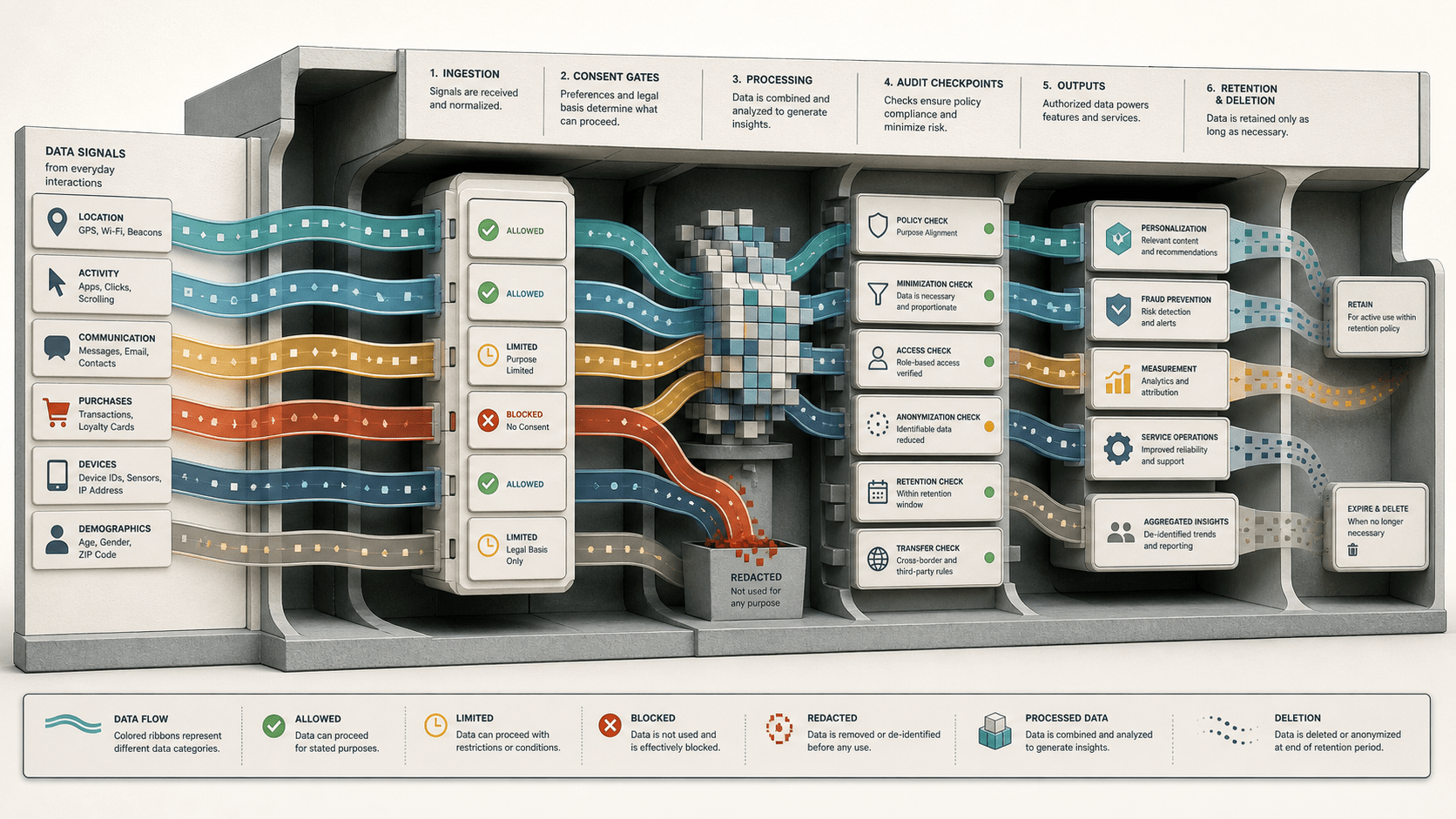
Most marketing teams still talk about privacy as if it were mainly a banner, a settings page or a legal checklist that appears near launch. That view is now too shallow. MarTech’s July 13 article on the California Invasion of Privacy Act is a reminder that digital tracking risk has moved deeper into the stack. The issue is no longer just whether users see the right disclosure language. It is whether your team can explain, in operational detail, what your tools collect, where the data flows and how much of your measurement model depends on those flows staying untouched.
That shift matters because privacy exposure is starting to change how marketers have to work with analytics, product and legal teams. If your organization cannot describe what session replay, consent logic, analytics scripts and downstream vendors are doing, then you do not just have a legal visibility problem. You have a systems maturity problem.
Why privacy risk is no longer a banner-copy problem
CIPA is not new law. What is new is the intensity with which it is being pulled into disputes over modern digital tracking. According to MarTech, legal teams increasingly need marketing teams to explain how data collection actually works, what tools are in use and what the commercial impact would be if those tools had to change. That alone should reframe the issue.
For years, many teams treated privacy work as communication polish layered on top of an unchanged measurement machine. Keep the stack, adjust the notice. But when the tracking layer itself becomes part of the risk conversation, that shortcut breaks down. Suddenly the questions are more architectural: Which vendors see what? Which signals are necessary? Which events are duplicated? Which tools are doing more than the team assumes? Those are not copy questions. They are operations questions.
This is why the topic deserves leadership attention. A team that cannot map its own collection logic is not in a strong position to defend its measurement strategy, redesign it or estimate the business cost of changing it.
What CIPA changes inside the marketing stack
The practical impact is not that all analytics become impossible overnight. The practical impact is that marketing, analytics and legal can no longer work in sequence. They have to work together earlier. MarTech notes that some companies began settling after early rulings denied motions to dismiss, even though the legal picture is still evolving. That uncertainty is exactly what raises the operational pressure.
When uncertainty rises, documentation and internal understanding become more valuable. Teams need to know what each tool captures, where data is sent, how consent is recorded and which business decisions rely on that signal. Otherwise, every legal question becomes a fire drill and every privacy adjustment becomes a guess.
There is also a second-order effect: privacy changes often reveal stack sprawl. Once companies start tracing collection and access pathways, they discover overlapping vendors, unclear ownership and legacy scripts nobody feels responsible for anymore. In that sense, privacy pressure can become an unwanted but useful audit of marketing technology discipline.
How teams should rebuild tracking decisions with legal before crisis mode
The right response is not panic and it is not denial. It is cross-functional fluency. Legal should understand what the stack is trying to achieve. Marketing should understand what the risk questions actually are. Analytics and implementation teams should be able to explain data flows without turning the answer into a scavenger hunt.
That means building regular working contact before a dispute forces everyone into reaction mode. It means mapping tools and events while the team still has time to simplify. It means treating privacy-safe redesign as a business tradeoff exercise, not just a compliance exercise. Some signals may become harder to capture or justify. If so, leaders need to decide what measurement quality matters most and where first-party design, consent strategy or process changes can preserve value.
The larger lesson is straightforward. Tracking is no longer an invisible utility sitting beneath campaigns. It is part of the brand’s operating credibility. The teams that understand their own data collection architecture will adapt faster and make cleaner tradeoffs. The teams that do not will keep discovering, too late, that their stack was less understood than they assumed.