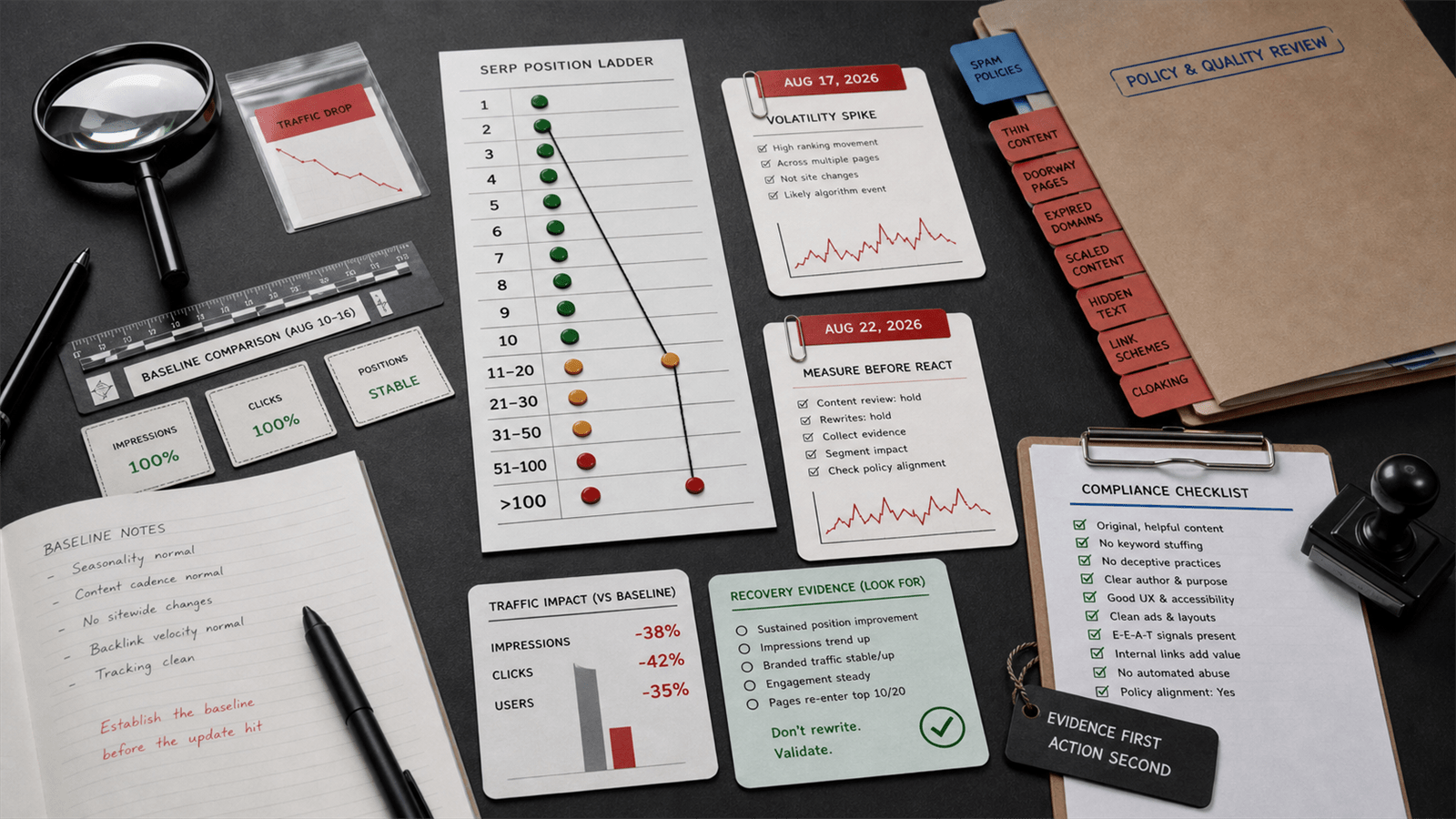
The August 2026 Google spam update has moved from calendar event to measurement problem. Google’s Search Status Dashboard says the rollout began on August 18 and finished on August 21, applying globally and across languages. Search Engine Land then reported SE Ranking data showing a sharper-than-normal level of top-10 URLs falling beyond the top 100 during the update window.
That combination creates a practical trap for marketing teams. The update was real, and the visibility swings were material. But a visibility drop during the same week is not, by itself, proof that every affected page violates spam policies. Recovery work should start with segmentation, not panic rewriting.
Build the baseline first
Use the week before the rollout as the control period. Pull Search Console queries, landing pages, countries, devices and page types for August 10-17, then compare them with August 18-22 and the first stable days after completion. Keep brand queries, seasonal pages and newly published URLs separate so they do not distort the diagnosis.
The first useful question is not “what did Google punish?” It is “which URLs behaved differently from their own baseline, and did similar pages behave the same way?” If only a narrow template, market or content type collapsed, the fix is more specific than a site-wide content rebuild.
Separate policy risk from ordinary volatility
Google’s spam policies focus on practices such as scaled low-value content, cloaking, hidden text, doorway pages, manipulative links and other behavior designed to deceive users or search systems. A ranking loss should therefore be reviewed against those mechanisms rather than vague quality anxiety.
Create three buckets. The first is technical noise: tracking changes, indexing delays, canonical conflicts or reporting lag. The second is competitive volatility: rivals gained or SERP features changed while your page remained healthy. The third is policy-risk evidence: pages that are thin, duplicated, over-templated, link-manipulative or created mainly for search capture.
What to fix first
Prioritize fixes where evidence and business impact overlap. A money page that lost non-brand demand and also shows thin intent coverage deserves attention before a long-tail archive page. Remove or consolidate doorway-style pages, add real editorial value where a page exists only to target a variant keyword, and document link cleanup decisions.
Do not publish a wave of rushed rewrites with no hypothesis. That can reset internal expectations, confuse QA and make later measurement impossible. A better recovery log records the affected URL, baseline, suspected mechanism, exact change, publish date and expected validation signal.
The executive view
For a CMO or owner, the August update is a governance test. SEO recovery should answer whether the site has a content-quality problem, a measurement problem, or a portfolio problem where too much traffic depends on fragile pages. The fastest teams will not be the ones that change the most pages; they will be the ones that can prove which changes were necessary.