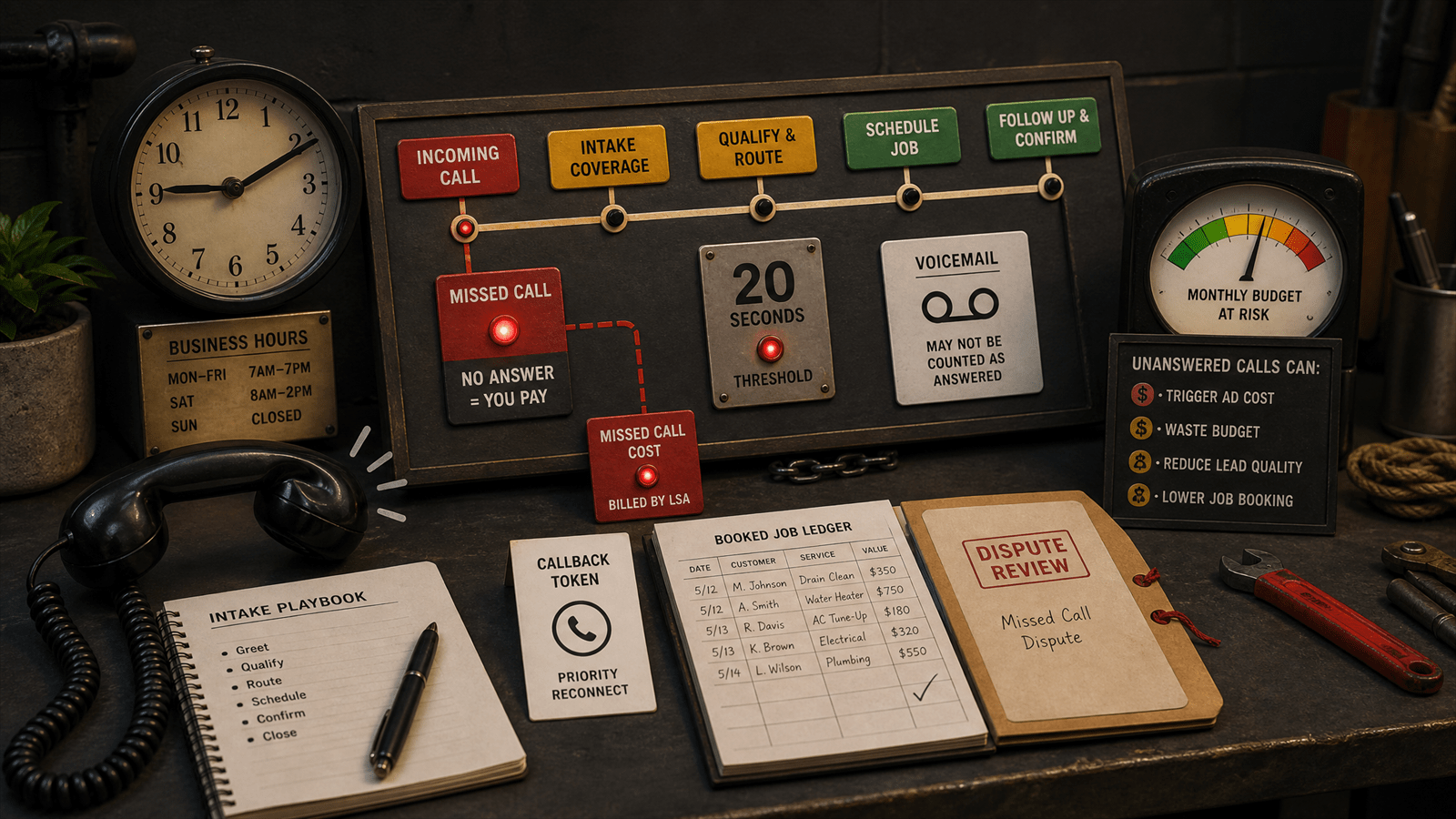
Google Local Services Ads may soon make a weak intake process more expensive. Search Engine Land reported on August 25 that Google will start charging some Local Services Ads advertisers for certain missed and follow-up calls from October 1, 2026. The practical issue is not only the charge rule. It is that a business can pay for demand that nobody was ready to handle.
For local services, a lead is not an abstract conversion. It is a phone call, message or booking request that has to be answered, qualified, routed and turned into a job. Google’s own Local Services documentation says advertisers receive leads directly as calls and messages, can track bookings and can manage lead activity online. It also warns that regularly failing to answer calls or respond to messages can affect ad ranking.
What changed
The reported update adds a sharper cost consequence around missed calls during business hours and qualifying follow-up calls. Advertisers should treat the exact account notice as the source of truth for their market and vertical, because public help documentation may not describe every rollout detail yet.
Still, the direction is clear enough for planning. Local Services Ads already sell on a lead model, not a click model. If a call comes from paid visibility, the media team cannot stop its accountability at campaign setup. The phone path has become part of the campaign.
Why missed calls become a media problem
A missed paid call creates three problems at once. First, the customer may choose a competitor. Second, the business may carry lead cost even when no one spoke to the caller. Third, the account data becomes harder to trust because spend, valid leads and booked jobs no longer describe the same thing.
This is where many small and mid-sized service businesses get hurt. They optimize bids and budgets but leave business hours, call routing, voicemail, staff coverage and lead feedback to habit. That separation is risky when the billing unit is a real customer contact.
The intake checklist before October 1
- Compare Local Services business hours with actual staffed phone coverage, including lunch breaks, weekends and holidays.
- Test the full route from ad click to phone answer, voicemail, callback and booking note.
- Document what happens when an IVR, receptionist, outsourced center or mobile forwarding path fails.
- Define who reviews missed calls, lead feedback, disputes and booked-job outcomes each week.
- Separate missed-call rate, answered-call rate, qualified-lead rate and booked-job rate in reporting.
- Set a temporary October review period before increasing budget.
What to measure after the change
Do not judge the update only by total spend. Compare the four weeks before October 1 with the first four weeks after it. Look at missed calls during listed business hours, answer time, voicemail returns, follow-up charges, booked jobs, refund or credit outcomes and cost per completed job.
If cost rises but booked jobs do not, the first fix is usually intake coverage, not a bid cut. If call handling improves and lead quality remains strong, then budget can be increased with better evidence.
The budget decision
Owners and PPC leads should decide whether Local Services Ads are being managed as a media channel or as a full lead system. A weekly budget only works when the business can answer the demand it buys. Before October 1, the useful question is simple: are we staffed, routed and measured well enough to pay for every valuable call we create?