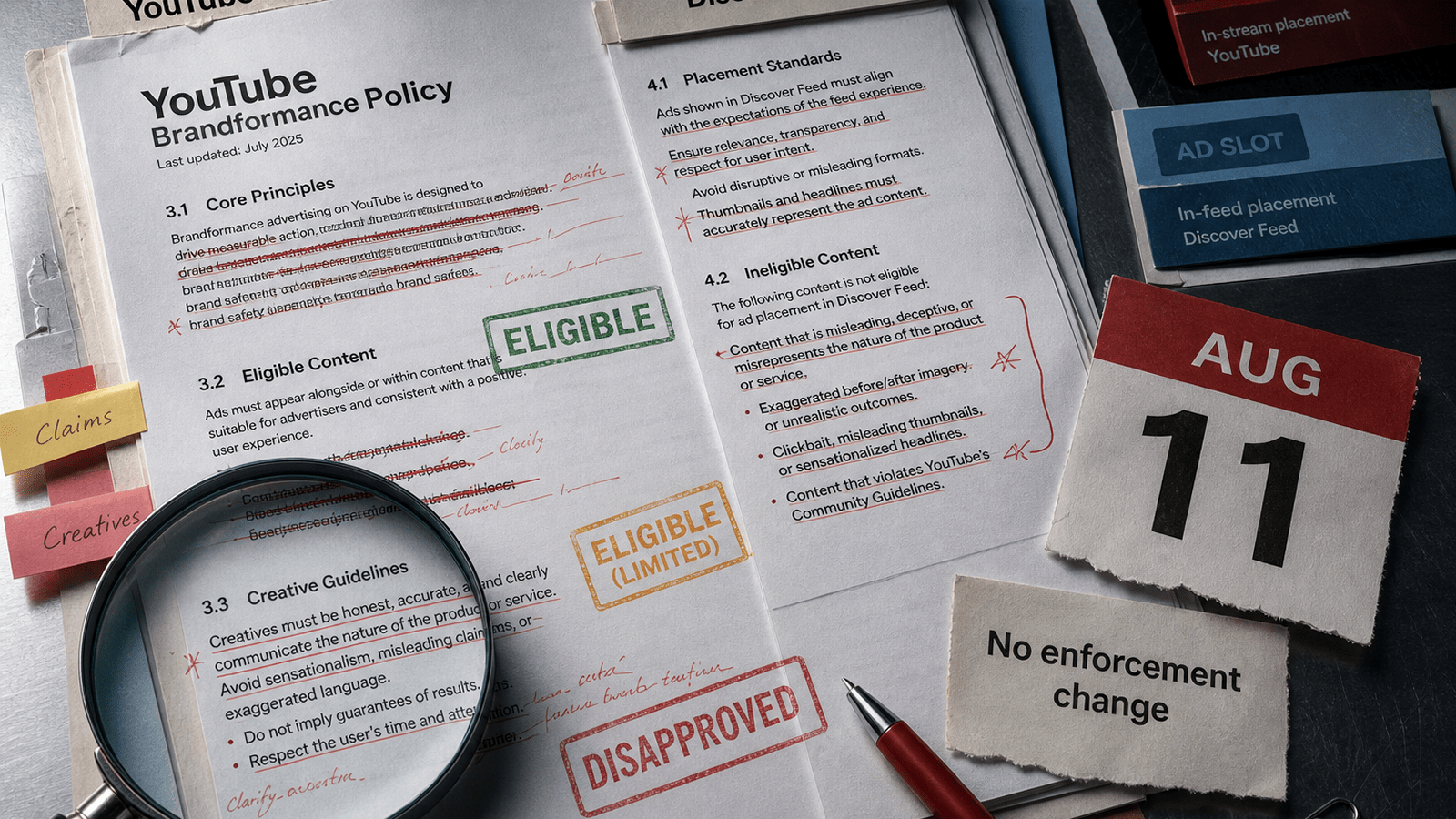
Google updated the YouTube and Discover Feed ad requirements on August 11, 2026 and described the change as a readability update with no enforcement scope change. Many teams read that as a non-event. Operationally, that is a mistake.
When policy reference pages are rewritten, review interpretation, QA checklists, and creative sign-off patterns can drift. Even if legal scope is unchanged, campaign execution risk can rise because teams keep working from old internal checklists while approvals are judged against a newly structured document.
What changed on August 11, 2026
The policy page now reiterates review mechanics and status outcomes in one place: Eligible, Eligible (Limited), and Disapproved. It also keeps strict language around misleading claims, negative imagery, and improper content. Google’s policy update notice says the change was made for clearer guidance, not broader enforcement.
Google also keeps important carve-outs and constraints visible in the same framework:
- Election ads are exempt from these YouTube/Discover-specific requirements, but not from Google Ads policies overall.
- Professional media content may be reviewed under a modified standard, but only with clear context and no blanket exception.
- Masthead placements can face stricter format requirements than other surfaces, so assets can fail masthead review while still serving elsewhere.
What did not change, and why that still matters
No direct enforcement scope change does not mean no delivery risk. For a performance team, risk appears in three places: review latency, unexpected disapprovals, and launch sequence failure when one asset is reused across Demand Gen and YouTube/Discover surfaces.
In practice, the budget question is simple: if a weekly launch misses two days because of preventable policy friction, your model loses more than a small creative QA investment would cost.
A practical preflight model before launch
1. Policy-to-asset mapping
Create a one-page matrix that maps every asset family (video, image, headline, app CTA) to likely disapproval classes. Keep examples of past disapprovals by class, not by campaign name.
2. High-risk creative flags
Flag claims language, urgency cues, before/after framing, and sensitive-category visuals before export. If a concept needs contextual explanation, include that context in visible creative framing rather than relying on internal notes.
3. Surface split for launch timing
Do not tie all spend to a single asset set on day one. Keep a policy-safe baseline variant ready so budget pacing is protected while borderline creatives finish review.
4. Weekly policy-drift check
Review disapproval reason patterns every week. If a reason class starts rising, update your checklist immediately and brief creative + media together.
Executive takeaway
The August 11 rewrite is not a headline about new restrictions. It is a governance signal. Teams that treat documentation changes as execution inputs will protect launch reliability, spend pacing, and reporting credibility better than teams that wait for visible enforcement shocks.
Sources
- PPC Land: Google rewrites YouTube and Discover ad rules (Aug 12, 2026)
- Google Advertising Policies: YouTube and Discover Feed ad requirements
- Google Advertising Policies: YouTube and Discover Feed ad requirements (April 2026 update note)