The interesting part of IRL media is not that out-of-home has found a new label. It is that OOH, experiential activations, venue moments and city-level journeys are being packaged as one story. For brands, that creates a planning opportunity and a measurement problem at the same time.
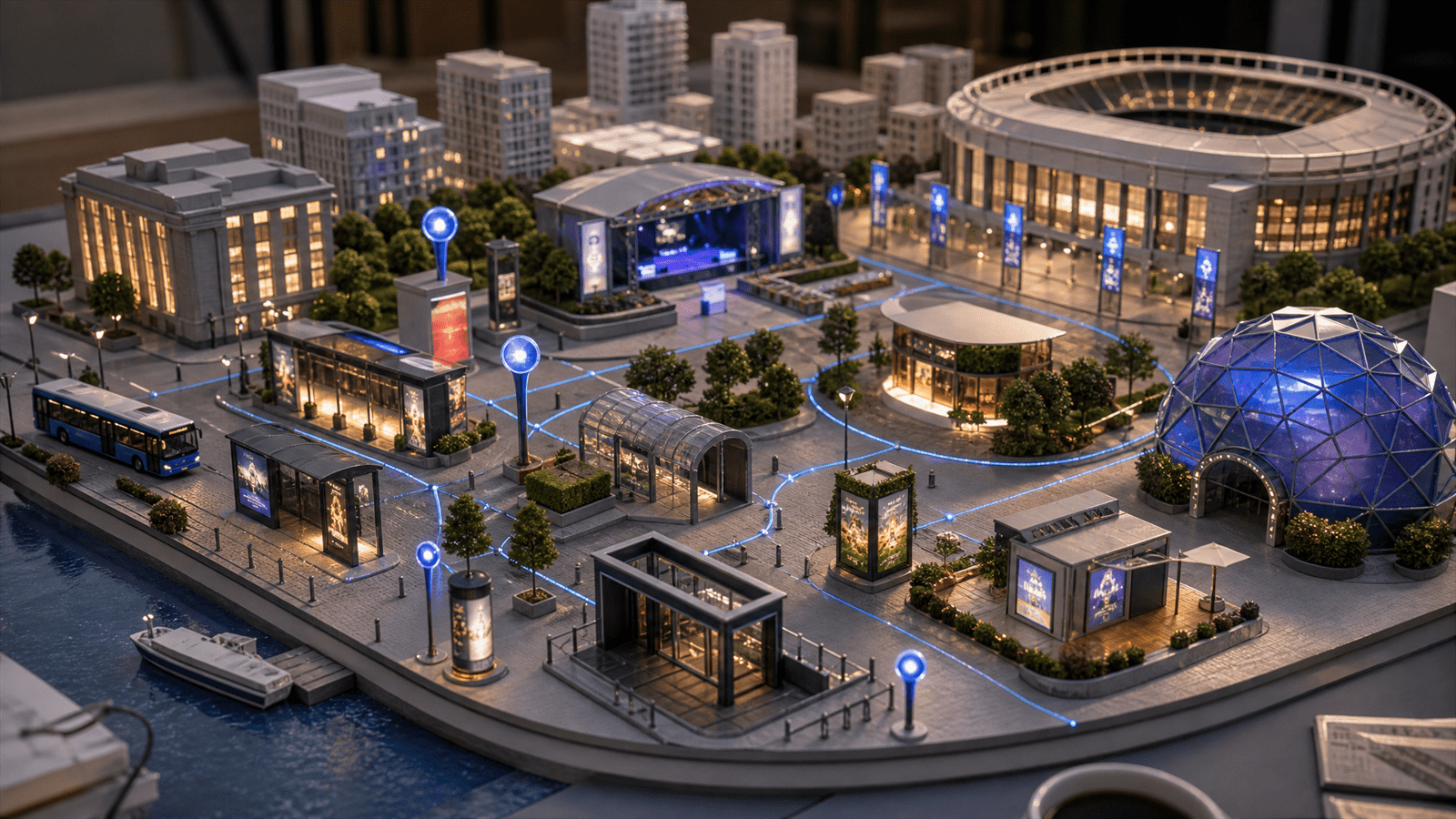
Marketing Dive reported on Sept. 14 that the New York Jets and Outfront are extending OOH marketing into what Outfront calls IRL media. The idea goes beyond billboards, bus shelters and digital signage to include pop-ups, interactive brand experiences and coordinated touchpoints around the fan journey. The same logic, Outfront suggested, could apply beyond sports to major B2B conferences that take over host cities.
Why this is more than outdoor reach
OOH has momentum because it offers physical presence while many digital channels feel more automated, fragmented and easy to ignore. Marketing Dive cited World Out of Home Organization projections that global OOH ad spending will reach $56.4 billion in 2026, up 4% over 2025. It also cited OAAA and Harris Poll research that 73% of consumers view digital OOH more favorably than several other ad channels, plus Harris Poll and Quad research that 76% of consumers say in-person brand interaction deepens connection.
The strategic lesson is not “buy more outdoor.” The lesson is that real-world media can carry a sequence. A fan may see a station panel, pass a street activation, encounter a partner offer near a venue, scan a code for utility and later recognize the same story in digital retargeting. That is different from buying isolated impressions.
A measurement model for IRL media
Start with the audience journey, not the format list. Define the physical moments where the audience is already gathering, waiting, moving or deciding. Then assign a role to each touchpoint: awareness, orientation, participation, offer capture, social sharing or sales support. If every placement has the same job, the plan is not a journey; it is just reach.
Next, separate measurement into three layers. Exposure metrics answer whether the audience had a reasonable chance to see the work. Engagement metrics answer whether people interacted with the physical or digital extension. Business metrics answer whether the campaign influenced store visits, event attendance, lead quality, search demand, partner sales or brand lift. QR scans are useful, but they should not be the entire proof plan.
Where marketers should be careful
IRL media can be harder to measure than click-based channels. That does not make it weak; it means the proof model must be agreed before launch. Decide which outcomes are directional and which are decision-grade. Decide whether the campaign needs a control market, brand-lift study, footfall analysis, promo-code logic or CRM matching. Also decide which effects are not measurable enough to claim.
The Jets and Outfront case is useful because it reframes OOH as a connected system. But brands should not buy the language without the operating model. Strong IRL media planning links place, audience behavior, creative sequence and measurement. Without those links, a campaign may be memorable, but the budget conversation will still struggle when finance asks what changed.