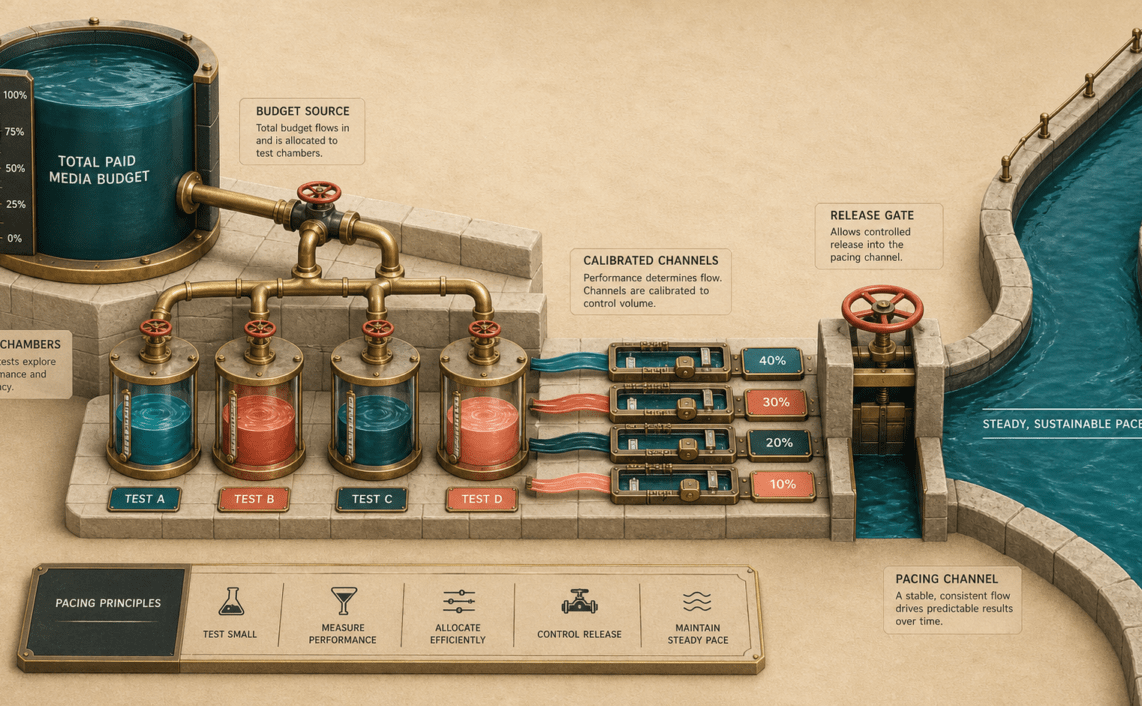
It is easy to explain rising CAC as a media problem. Auctions are tighter. Buyers are harder to reach. Competition is more intense. All of that can be true. It can also be incomplete. A July 9 article in MarTech makes a more uncomfortable argument: many teams are spending more to reach people who trust them less, then wondering why deal quality does not improve with the extra budget.
That diagnosis matters because it changes the response. If the problem is only channel cost, the instinct is to squeeze bids, renegotiate vendors or chase the next efficient placement. If the problem sits between awareness and trust, the answer is different. Then the issue is not simply how many people you reached. It is whether the right people received enough proof, relevance and confidence to move forward in a real buying process.
Why more top-of-funnel spend can still make deal economics worse
Many B2B teams assume that if pipeline quality is soft, they need more volume at the top. That logic breaks down when additional reach mostly buys attention from people who are not a strong fit, are not ready to believe the claim or cannot see enough evidence to take the next step. The campaign can look active while the commercial outcome stays flat. CAC rises because the system is paying to create surface-level awareness that never matures into serious consideration.
This is one reason the CAC conversation often becomes distorted. Leaders treat acquisition cost as if it were driven mainly by platform efficiency. But cost is also shaped by message credibility, audience quality and the amount of proof required in the category. When those layers are weak, more reach can actually intensify the problem. The company buys more impressions, generates more touchpoints and still fails to improve deal velocity or close quality.
MarTech’s framing is useful because it puts a spotlight on the missing transition between awareness, confidence and trust. Awareness tells the buyer you exist. Confidence tells them your offer may be relevant. Trust tells them the promise is credible enough to risk time, budget or internal political capital on the next step. Many funnels are built as if awareness naturally turns into trust. In reality, that middle work has to be earned.
The missing layer sits between awareness, confidence and trust
This is where a lot of modern demand generation gets exposed. AI tools now make it easier to scale outreach, create more content variants and personalize creative at a much higher tempo. That sounds efficient, but scale does not automatically produce belief. If the offer is weak, the evidence thin or the audience poorly matched, AI can simply accelerate low-quality reach. The machine gets faster. The buyer does not get more convinced.
Mark Stouse’s line that many teams are spending more to reach people who trust them less is useful precisely because it sounds severe. It forces a better question than, “How do we lower CAC?” The better question is, “Where exactly does our market stop giving us enough trust to move forward?” That may be a proof problem, a positioning problem, a category-confusion problem or a handoff problem between marketing and sales. But it is rarely solved by adding more top-of-funnel noise alone.
For leadership teams, the practical implication is that proof should be treated as part of acquisition economics, not as optional brand garnish. Case evidence, category credibility, social proof, partner validation, product clarity and sales-readiness all help determine whether paid reach becomes expensive waste or productive demand. When these assets are weak, the funnel leaks before a serious buying conversation begins. CAC rises because too much budget is spent creating attention that cannot carry its own weight.
How B2B teams should repair proof before buying more reach
The right fix is not to abandon reach. It is to sequence reach behind stronger fit and stronger proof. Audit which campaigns are filling the pipeline with names that never gain confidence. Look at where deals stall and what objections repeat. Check whether your content actually resolves buyer uncertainty or just restates your positioning in new formats. If sales is repeatedly rebuilding trust from zero, marketing probably is not handing over conviction, only awareness.
This is also why CAC should be read as a downstream symptom rather than a standalone verdict. It reflects not only what media costs but what your market believes. When trust is weak, acquisition gets more expensive because every next step requires more compensation through spend, repetition and sales effort. When trust is stronger, CAC can improve without a miracle in channel pricing because more of the audience already has enough confidence to progress.
The broader lesson from MarTech is that efficiency pressure can tempt teams into the wrong optimization loop. They buy more reach to compensate for weak conversion, then make the trust problem larger by flooding the market with more undifferentiated messaging. The smarter move is slower and harder: tighten fit, sharpen evidence and treat belief as part of the operating system of demand generation. That is not softer than performance marketing. In many categories, it is what performance marketing now requires.