Marketing teams rarely fail because they have too few ideas. They fail because too many tasks enter the system without proving they deserve capacity. MarTech’s August 14 article on deciding what matters when everything feels urgent is useful because it treats prioritization as an operating system, not a mood. Every request has to justify its place against objectives, KPIs, effort and reuse.
That is a serious CMO issue. A team can look fully loaded and still spend the week on work that does not move demand, retention, margin or customer experience. Asana’s work-management research describes the broader problem as work about work: communication, document hunting and shifting priorities replacing the skilled work people were hired to do. TMetric’s meeting analysis adds another capacity warning. The agenda is not neutral. It consumes the budget.
Why urgency breaks marketing
Urgent requests usually arrive with social pressure, not a business case. A sales leader needs a deck today. A product manager wants a landing page. A founder saw a competitor post. A channel owner wants another campaign variant. Some of these requests matter. Many are merely visible.
If the team accepts the queue in arrival order, strategy becomes whatever shouted last. The result is familiar: scattered campaigns, unfinished experiments, weak follow-through and a reporting meeting where everyone was busy but no one can explain which metric improved. The fix is not telling people to focus harder. The fix is changing the intake rule.
The three-gate intake model
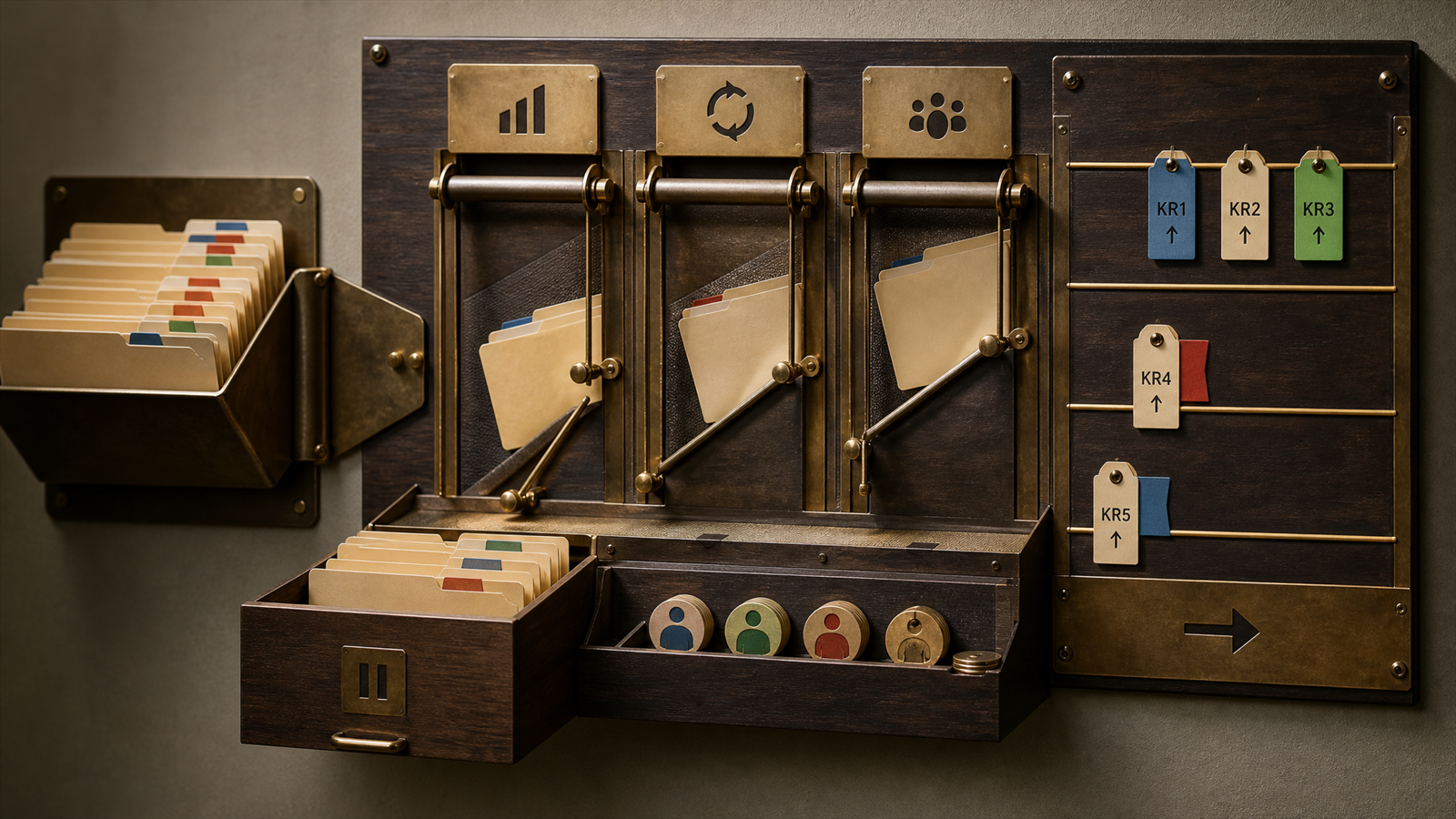
Before a task enters the sprint, make it pass three gates. First, metric fit: which OKR and KPI does this task affect? If the answer is vague, the task is not ready. Second, effort return: is the likely impact worth the hours, dependencies and review cycles? A two-day task that moves a metric less than a two-hour task should not win just because it arrived with urgency. Third, reusable value: does this create an asset, learning, process or automation that can compound?
These gates do not kill creativity. They protect it. A better brand film, lifecycle test or SEO guide needs room to be built properly. When every small request gets equal access to the team’s calendar, the work with the highest upside loses oxygen.
How to cap priorities
A useful rule is to cap strategic priorities by horizon: a few for the quarter, fewer for the month, and a very small number for the week. The cap forces tradeoffs into the open. When a new task appears, the question becomes: which active priority should move, pause or shrink? If nobody wants to name the tradeoff, the request probably belongs in the backlog.
This also changes stakeholder conversations. Instead of saying the team is too busy, marketing can say: this is not tied to the current KPI plan, or this would displace the launch work expected to improve activation, or this is useful but not reusable enough for this sprint. That language is harder to dismiss because it is about business choices, not personal workload.
Where automation belongs
AI and workflow automation should enter after the task map is visible. Routine reporting, keyword clustering, competitor monitoring, briefing templates and QA checks may be good candidates. Judgment-heavy work such as positioning, final editorial review, sensitive customer messaging and creative direction should remain deliberately human-led, even if AI assists parts of the process.
The practical move is to maintain an automation backlog with owner, state and next review date. Do not automate whatever is loudest. Automate repeatable work that protects strategic time. The goal is not to make the team look futuristic; it is to return capacity to the work that changes outcomes.
A scorecard for the CMO
- Share of team time spent on growth work versus routine coordination.
- Share of sprint tasks linked to an OKR and KPI.
- Number of active priorities by quarter, month and week.
- Routine hours moved into reliable workflow or AI assistance.
- Requests rejected, deferred or reshaped because the tradeoff was explicit.
- Planned priority hours compared with actual time spent.
This scorecard turns “we are busy” into evidence. It also gives marketing a cleaner answer when stakeholders ask for more output. More output is not the same as more progress. A priority triage system gives the team permission to choose the work that earns capacity.
The CMO takeaway is direct: do not let urgency become the operating model. Make every task prove the metric, the effort case and the reusable value before it enters the sprint. Then automate the routine that keeps pulling the team away from growth.