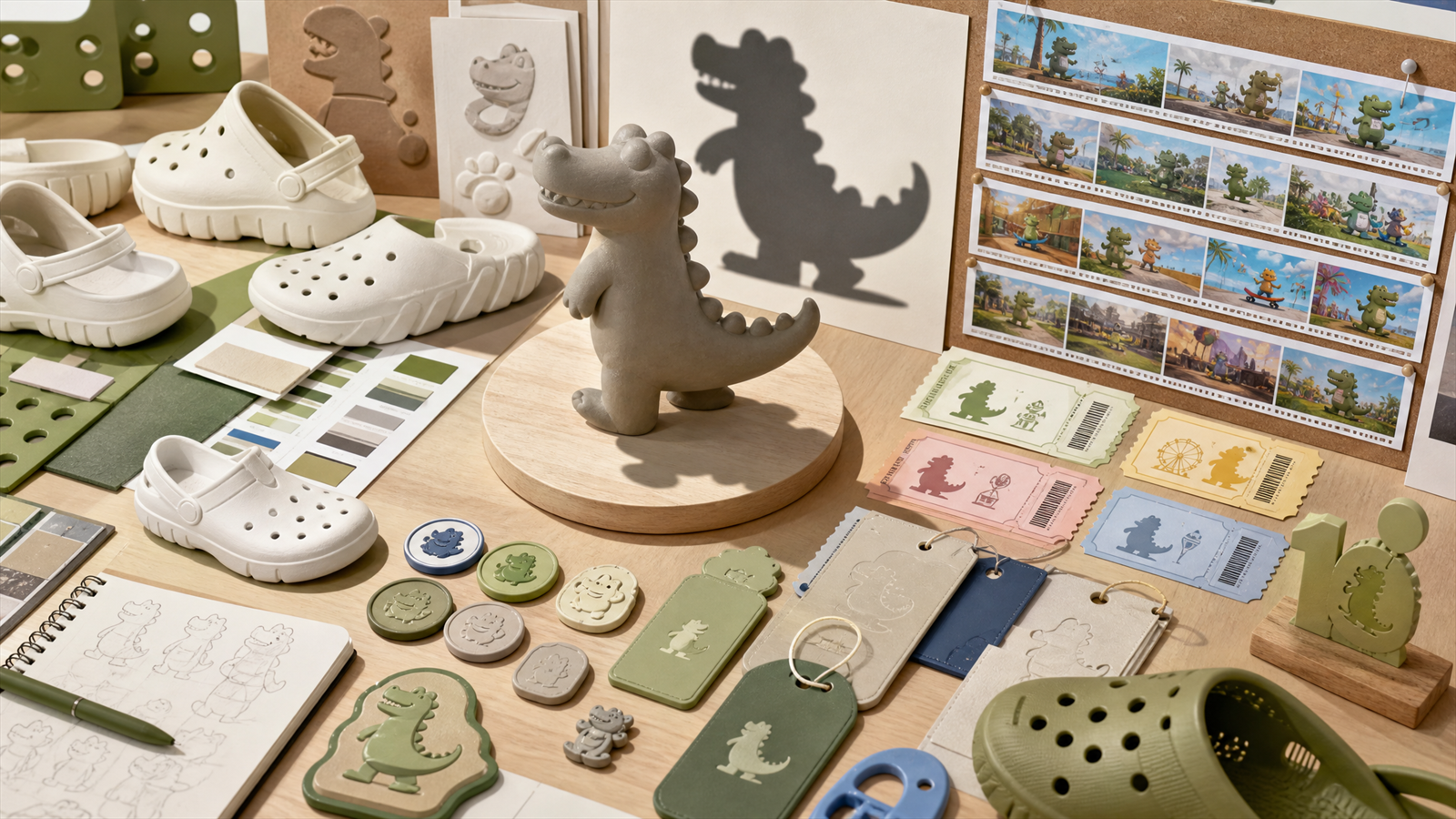
Crocs introducing Niles could be dismissed as a cute mascot story. That misses the more useful marketing lesson. Marketing Dive reported on August 14 that the 6-foot character will appear in social content, experiences and other activity, while Crocs’ own release frames Niles as a long-term investment in scalable intellectual property. That phrase matters more than the costume.
A mascot is not automatically a brand platform. It becomes one only when the character carries existing brand codes, has a role in content, can extend into commerce and experiences, and is governed tightly enough that novelty does not turn into noise. Crocs has some natural advantages: the crocodile has been hidden in the brand name and logo since the beginning, the product silhouette is already distinctive, and the brand has been active in social storytelling and TikTok Shop formats.
What Crocs launched
Niles arrives ahead of Crocs’ 25th anniversary in 2027 after teaser activity that included a large egg appearing in brand assets. The launch includes a microseries shot at headquarters and a dedicated social presence. Marketing Dive notes that the character does not speak but has personality, interests, flaws and ambitions, which is closer to a repeatable content character than a static brand ambassador.
The first-party release makes the strategic intent explicit: Crocs wants a platform that can evolve across content, experiences, entertainment and future extensions. That is why marketers should look beyond whether the mascot is likable. The stronger question is whether the asset can create memory, participation and commercial paths without separating from the product.
Why mascot IP can work
Fragmented media makes consistent brand memory harder. A character can act as a portable cue across short video, retail events, product drops, creator collaborations, livestreams and owned channels. It gives the brand a repeatable face when individual campaigns disappear quickly. It also reduces dependence on borrowed fame from celebrities or trends.
But the same structure can fail. A mascot that has no connection to the product becomes decoration. A character with no rules becomes inconsistent. A launch measured only by views may look successful before anyone knows whether it improved recall, preference, search demand, repeat visits or commerce behavior.
The decision model
- Brand code: does the character grow from an existing asset, name, shape, ritual or customer joke?
- Role: is the character a host, product guide, comedy engine, community member, educator or event marker?
- Channel fit: can it work in social video, store experience, packaging, product launches and customer service without feeling forced?
- Governance: are personality, voice, visual boundaries, approvals and misuse rules defined?
- Commerce link: can the character support product discovery, drops, bundles or loyalty moments without turning every appearance into a hard sell?
- Longevity: can it survive after the first week of curiosity?
This model protects teams from making a mascot because mascots are fashionable. The bar should be higher: the character must solve a memory or participation problem that ordinary campaign assets cannot solve as efficiently.
What to measure
Measure both cultural and commercial signals. Track character recognition, branded search around the character and product, social saves and repeat engagement, traffic from character-led content, product-page behavior, loyalty sign-ups, retail-event participation and whether creators or fans use the character without paid prompting. Also track fatigue: declining completion rates, negative sentiment and forced appearances in channels where the character does not help.
For ecommerce teams, the key is to connect character moments to shopping paths without flattening the character into a coupon. A mascot can make the brand more memorable, but the product still has to carry the promise.
The CMO takeaway
Crocs’ Niles is interesting because it treats a mascot as governed IP, not as a campaign prop. That does not mean every brand needs a character. It means every brand considering one needs a platform argument: what existing code it activates, what content job it performs, what commerce path it supports and what rules keep it consistent.
The practical lesson is simple. If the mascot is only cute, it will become expensive decoration. If it turns product heritage into a repeatable social and retail system, it can become a durable brand asset.