Walmart’s latest quarter is a useful reminder that ecommerce growth does not always make stores less important. It can make them more important. Retail Dive reported on August 20 that Walmart U.S. ecommerce sales grew 24% in Q2 FY27 and now represent more than 23% of the Walmart U.S. mix. Walmart’s own release highlighted 40% growth in store-fulfilled delivery and more than 50% marketplace net sales growth.
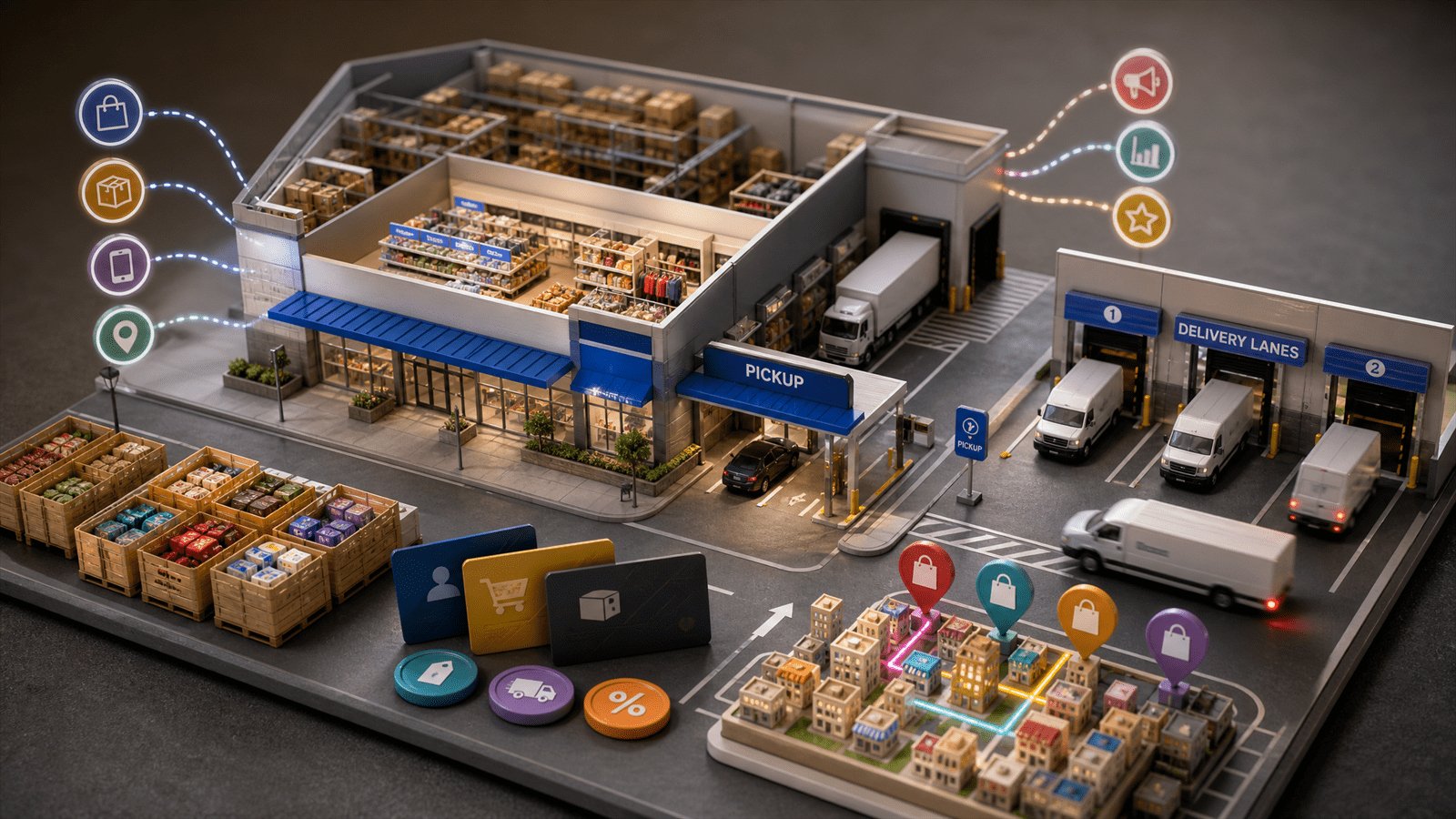
The marketing lesson is not that every retailer can copy Walmart’s scale. The lesson is that a store network can become digital infrastructure. When the same physical asset supports pickup, delivery, local inventory, marketplace assortment, membership value and advertising signals, the channel map changes.
What Walmart’s quarter says about stores
Retail Dive quoted CFO John David Rainey saying that stores have become more important as Walmart becomes more omni. That line matters because it challenges a lazy ecommerce narrative: online grows, stores fade. In Walmart’s model, stores are part of the reason online can grow. They shorten delivery distance, improve inventory confidence and make fast local service easier to promise.
The quarter also had complications. Pharmacy pricing regulation softened U.S. comparable sales, tariff refunds affected profit dynamics, and Walmart is operating at a scale most retailers cannot match. Still, the strategic pattern is clear: ecommerce, advertising, marketplace and membership are not separate stories. They depend on the same operating base.
Why stores become a digital asset
For marketers, the store is no longer only a place where transactions happen. It is a proof point in acquisition messaging: available nearby, delivered fast, returnable locally, supported by real inventory and trusted service. Those promises can improve conversion rates before the shopper ever enters the store.
The store also supplies media value. Retail media depends on shopper data, product availability, category context and sales outcomes. A store network gives the retailer more places where demand, inventory and purchase signals meet. But that does not mean every retail-media impression is incremental; it means the data foundation is richer and requires better measurement discipline.
A retail operating checklist
- Measure store influence on ecommerce orders, not only store sales.
- Connect local availability, pickup and delivery speed to paid search, social and email messaging.
- Expose inventory confidence in product pages and ads where possible.
- Align marketplace growth with fulfillment reality so assortment promises do not exceed service levels.
- Separate retail-media reporting from true incrementality before shifting major budget.
- Track returns, substitutions and delivery failures as marketing experience metrics, not only operations problems.
What smaller retailers should not copy blindly
Walmart has density, capital, supply-chain leverage and data that most companies do not. Smaller retailers should not assume that turning every store into a fulfillment node automatically improves margin. The economics depend on order density, labor, picking accuracy, delivery partners, inventory visibility and customer expectations.
The practical move is to identify where stores create a genuine advantage. That may be same-day pickup in a few priority markets, expert advice, local returns, product trials, service appointments or inventory trust for high-consideration products. The store should become a sharper promise, not a vague omnichannel slogan.
The CMO takeaway
Walmart’s results show that ecommerce marketing cannot be planned apart from operations. A campaign promising convenience depends on store execution. Retail media depends on product and transaction data. Marketplace growth depends on fulfillment reliability. Membership value depends on the whole system feeling faster and easier.
The next omnichannel plan should ask a simple question: what specific digital promise does the store make more credible? If the answer is unclear, the team is still managing channels. If the answer is measurable, the store has become part of the growth engine.