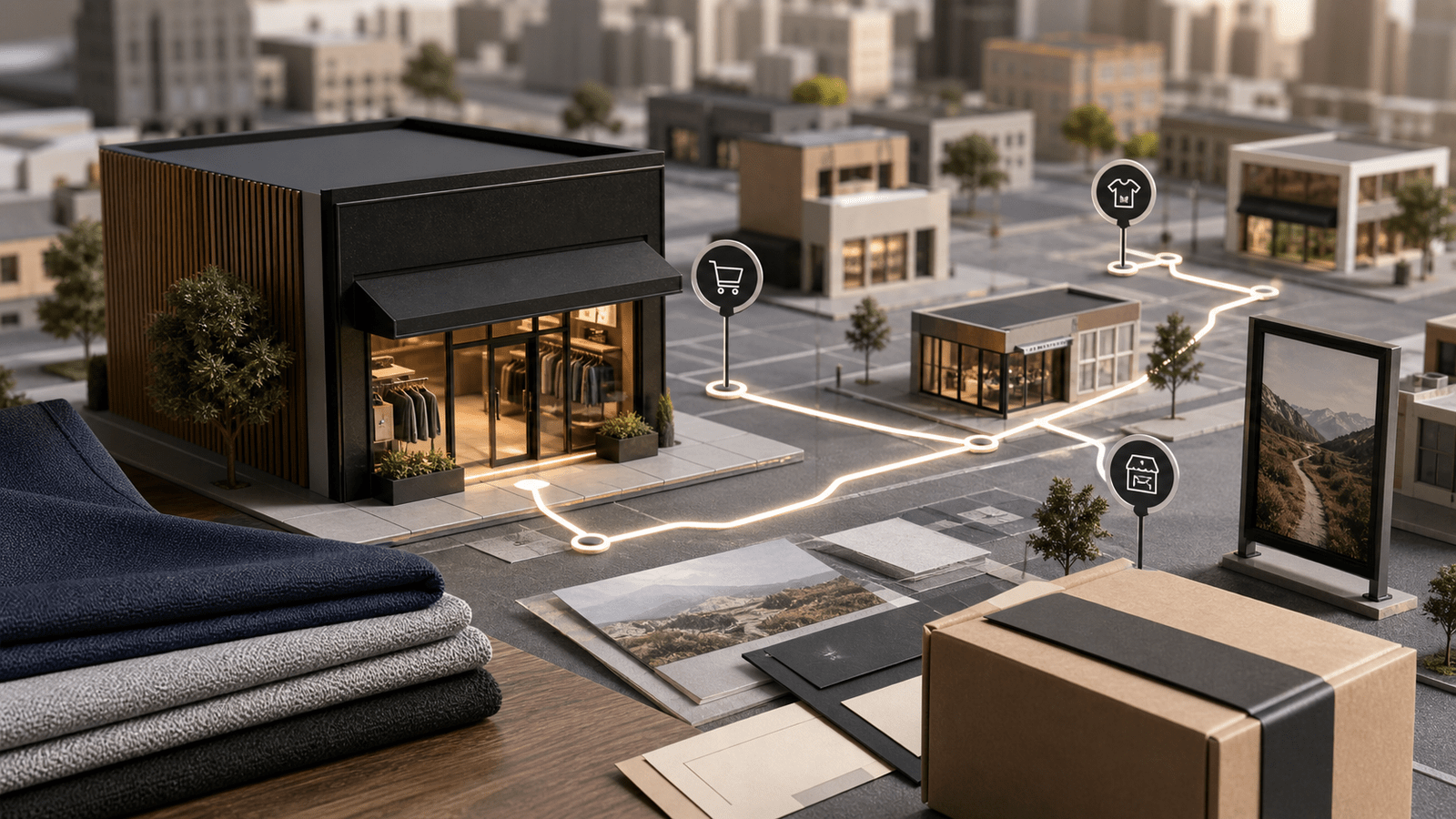
Rhone’s new “A Love Letter to NYC” campaign is easy to file as another apparel brand film. That misses the useful lesson. Marketing Dive reported on August 11 that the performance apparel brand is using the campaign as it expands beyond its DTC roots, grows retail and wholesale, and experiments with more upper-funnel work. The media mix spans linear, CTV, social, direct mail, print, out-of-home, retail and digital experiences.
That is the real story for ecommerce leaders. A DTC brand does not need upper-funnel marketing simply because it wants a prettier campaign. It needs it when the business model becomes harder to explain through one ecommerce conversion path.
Why this is more than a campaign launch
Rhone’s CMO told Marketing Dive the company had been focused on performance media for a long time because it is measurable and tied to ecommerce. But as wholesale and retail grow, the brand needs a more omnichannel approach. That sentence is the strategic trigger. Distribution changed, so the marketing system has to change.
Performance media is excellent at capturing and converting demand when the path is narrow. It is weaker at teaching a broader audience what the brand now stands for, supporting store traffic, giving wholesale partners confidence and making local activations feel connected rather than random.
The trigger: distribution changed
When a brand sells mostly through its own site, the dashboard can dominate the discussion. The team can optimize creative, landing pages and retargeting with relatively direct feedback. Once stores, wholesale partners and local experiences matter, the same dashboard becomes incomplete. Some of the value appears later, offline or through branded search and store visits.
That does not mean measurement should become vague. It means the measurement model needs more layers. A campaign like Rhone’s can support awareness, product repositioning, local relevance, retail traffic and wholesale confidence at the same time. Each role needs a different proof point.
A decision model for upper funnel
- Use upper-funnel investment when distribution has expanded beyond one direct conversion path.
- Define the business job first: store traffic, wholesale support, brand repositioning, category education or audience broadening.
- Connect every touchpoint to that job. OOH, CTV, social, direct mail and in-store activations should not tell five different stories.
- Keep a performance layer alive, but stop forcing every asset to prove itself only by immediate ecommerce ROAS.
- Review results by market density. Local activations work best where stores, media and audience concentration reinforce each other.
This model protects the useful discipline of performance marketing while acknowledging that a larger retail business needs memory, not only clicks.
What to measure
Start with leading indicators: branded search, direct traffic, store locator use, retail-market lift, wholesale partner feedback, social saves and audience quality. Then connect those signals to lagging outcomes: store sales, ecommerce conversion in exposed markets, repeat purchase and margin mix.
Do not demand that an outdoor placement behave like a search ad. Instead, ask whether the market with coordinated media, retail presence and local activation performs differently from comparable markets without that support. That is a better question for an omnichannel brand.
The lesson for retail brands
Rhone’s campaign has not yet proved a sales outcome, and marketers should avoid treating a launch article as a case study of success. The useful case is the decision logic. When a DTC business becomes a retail and wholesale business, the role of marketing expands from conversion pressure to market-making.
The CMO takeaway is direct: fund brand building when the commercial system needs it, not when the creative team wants a bigger canvas. If distribution, product positioning and customer behavior have changed, the media model should change too. The job is to build an upper-funnel system that still has accountable business questions attached.