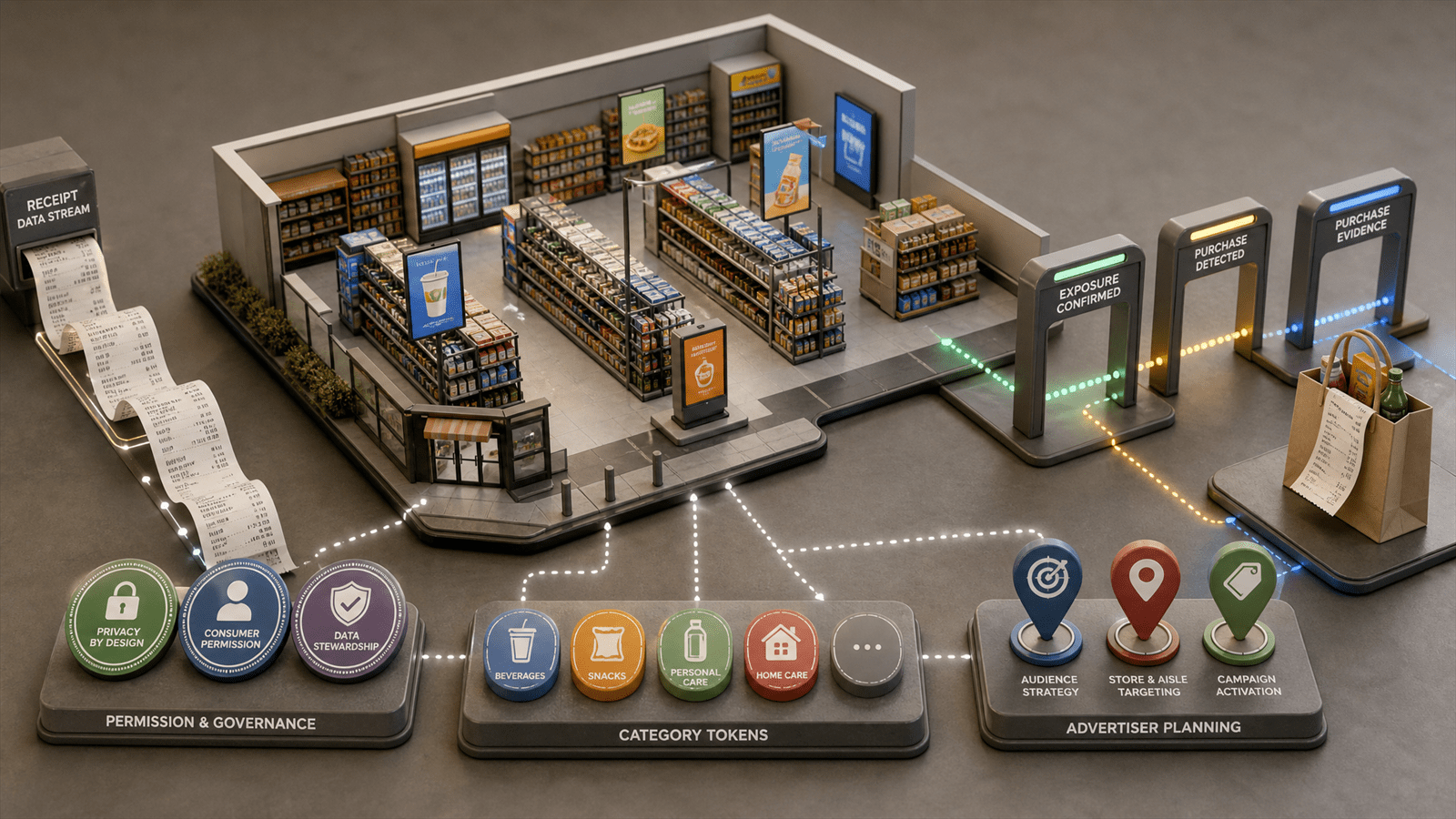
ITOCHU and Dentsu’s August 31 retail media alliance is more than a local partnership announcement. It shows where the category is heading: retail media is becoming an operating layer that combines store environments, purchase data, media execution and advertiser planning.
That shift matters for brands because a retail media network can no longer be judged only by reach or by a closed-loop sales chart in a deck. The stronger question is whether the network can connect attention, permissioned data and measurable commercial outcomes without hiding the assumptions between them.
What the alliance puts together
The ITOCHU announcement references Dentsu, retail media business development and assets connected with FamilyMart, Gate One and Data One. For marketers, the exact corporate structure is less important than the combination of capabilities: physical stores, media surfaces, purchase signals and advertising relationships.
Convenience retail is a useful test bed because visits are frequent, categories are broad and purchase behaviour can be close to media exposure. But that does not automatically make every impression valuable. It makes measurement design more important.
Why retail media is becoming an operating layer
The first version of retail media was often sold as audience access or sponsored listings. The next version looks more like infrastructure. Store screens, ecommerce placements, loyalty or payment signals, category planning and media buying need to work together.
This creates a new job for brand and ecommerce teams. They have to understand where data comes from, what the retailer is allowed to use, how media is delivered, and which outcome is actually being claimed. A purchase after exposure is not automatically incremental. A store screen is not automatically attention. A first-party signal is not automatically usable for every campaign.
The evaluation checklist for brands
Start with data permission. Ask what data is used, whether it is aggregated or person-level, how consent is handled and which partners can touch it. If the answer is vague, do not accept a precise ROAS claim later.
Then inspect media execution. Which formats are available in store and online? How is creative approved? Can frequency be controlled across surfaces? Who owns the store-level operational risk if media promises a product that is not available?
Finally, review measurement. Brands should ask for methodology, attribution window, baseline, holdout options, category context and whether results can be separated by store, region or shopper segment. Retail media is powerful only when the evidence can survive a finance conversation.
What to test before scaling
A useful pilot should be narrow. Choose a category, geography, store group or audience where the brand has a real commercial question. Define the expected behaviour before the campaign starts: trial, repeat purchase, basket expansion, store traffic or share shift.
Where possible, use matched markets or holdouts. If that is not available, at least compare exposed and non-exposed periods with the same promotional calendar and inventory conditions. Retail media tests fail when media, merchandising and supply chain all change at once and no one can explain which lever mattered.
The strategic lesson
The ITOCHU-Dentsu move is a reminder that retail media is not just another ad channel. It is a negotiation over data, store operations, commercial proof and media access.
Brands should welcome richer retail-media networks, but they should buy them with stricter questions. The winners will not be the teams that accept the biggest closed-loop promise. They will be the teams that know exactly what the loop contains.