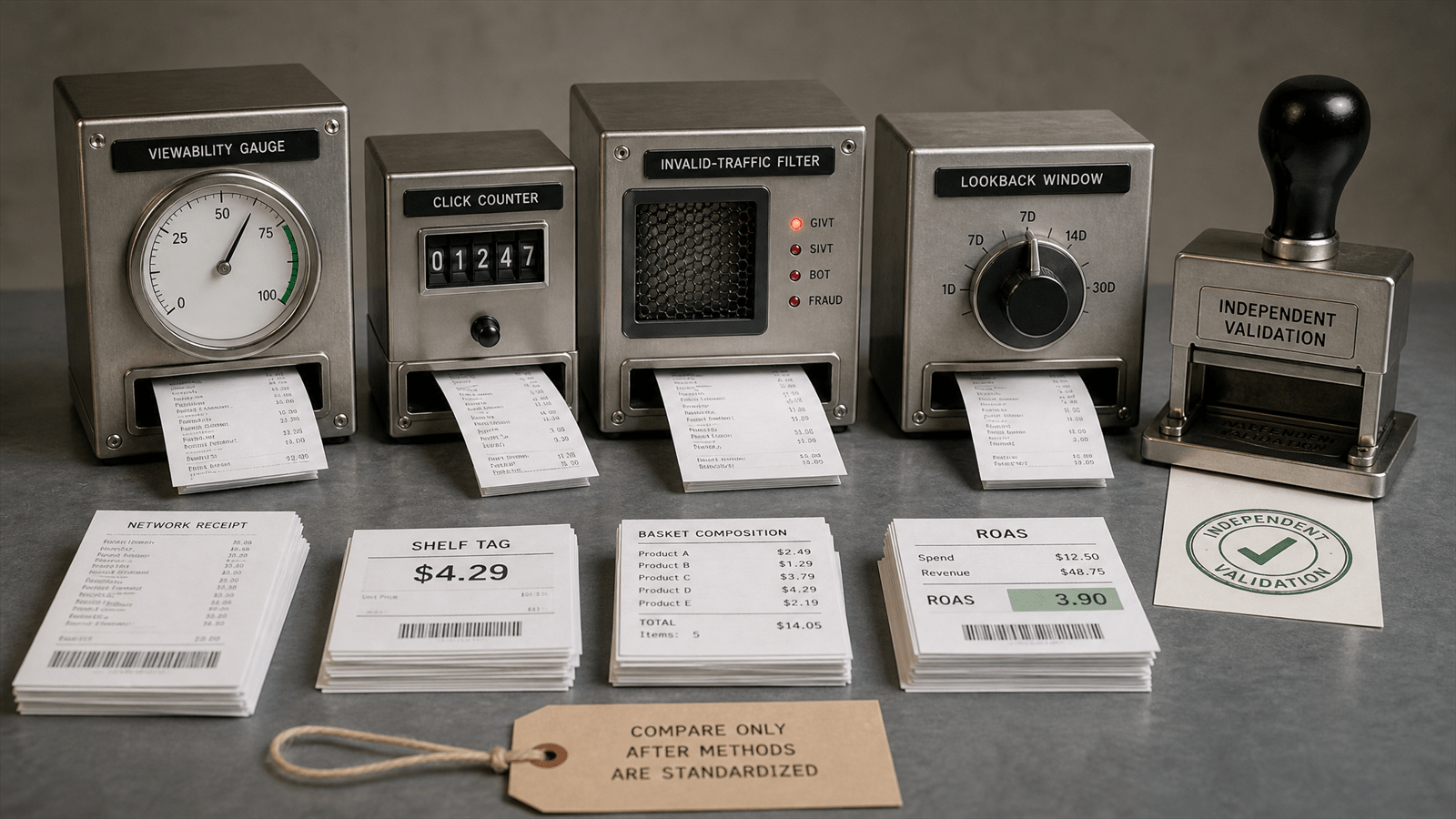
Retail media keeps winning budget because it promises proximity to purchase. That promise is useful, but it is not the same as comparable measurement. Marketing Dive reported on August 18 that the ANA is pushing for a shared retail media measurement framework and warning marketers not to rely too heavily on self-reported network data. For brands, the implication is practical: before comparing ROAS across networks, compare the measurement contract.
The ANA’s own Retail Media Measurement Standardization page says retail media is still growing, with Emarketer projecting a 17% compound annual growth rate through 2028 and a $90 billion market. When a channel reaches that scale, inconsistent reporting is no longer an analytics nuisance. It becomes a budget governance problem.
Why retail media ROAS is hard to compare
Retail media networks sit close to first-party shopper data, store sales, ecommerce transactions and shelf context. That is the channel’s strength. It is also why comparison is hard. Two networks may both report sales, but use different attribution windows, purchase scopes, product-category rules, audience definitions, invalid-traffic filtration or incrementality methods.
A high reported ROAS may reflect a strong media plan. It may also reflect a generous lookback window, a broad basket definition or a method that counts purchases the brand likely would have earned anyway. Closed-loop reporting is valuable, but it is not automatically neutral.
What ANA is trying to standardize
Marketing Dive reports that ANA’s early focus is inconsistent metrics, measurement methodologies and vocabulary, with longer-term ambitions around outcomes, incrementality, data sharing, integrations and experimentation. The article also notes that ANA wants more independent third-party measurement and accreditation, especially as marketers worry about fewer neutral ad-tech vendors after major M&A.
This follows earlier IAB and MRC work on retail media measurement guidelines. The important point for buyers is sequencing. Baseline media metrics such as impressions, viewability, clicks and invalid traffic need consistent treatment before outcome metrics can be trusted across networks.
A negotiation checklist for brands
- Ask each network to define impression, viewability, click, invalid-traffic filtration, attributed sale, new-to-brand customer and purchase scope.
- Require the attribution lookback window in writing and normalize it before comparing performance.
- Separate same-SKU, brand-level and category-level sales so basket expansion does not hide weak media quality.
- Ask what independent validation, audit status or MRC-aligned measurement the network can support.
- Negotiate access to sales volume, category movement, inventory status, pricing and basket composition where it affects campaign interpretation.
How to separate reporting from incrementality
Retail media reports can tell a brand what happened after exposure. They do not always prove what would not have happened without exposure. That distinction matters when retail media is tied to trade agreements, shelf leverage or retailer relationships. A campaign can look profitable while mostly capturing existing demand from loyal buyers.
The answer is not to distrust every network. It is to classify evidence. Use delivery metrics to confirm the media ran cleanly. Use sales reporting to understand observed purchase behavior. Use tests, holdouts or modeled baselines to judge incrementality. When those layers are mixed together, procurement and marketing end up arguing about a single ROAS number that carries too many assumptions.
The CMO takeaway
Retail media should not be managed only as a performance line item or a retailer relationship tax. It is now a serious media channel, and serious channels need measurement discipline. The next budget review should ask which networks are truly outperforming and which are simply reporting differently.
That does not require waiting for perfect standards. It requires refusing to compare unlike numbers. Before shifting more money into the next network plan, make the method visible. Measurement comparability is now part of retail media buying power.