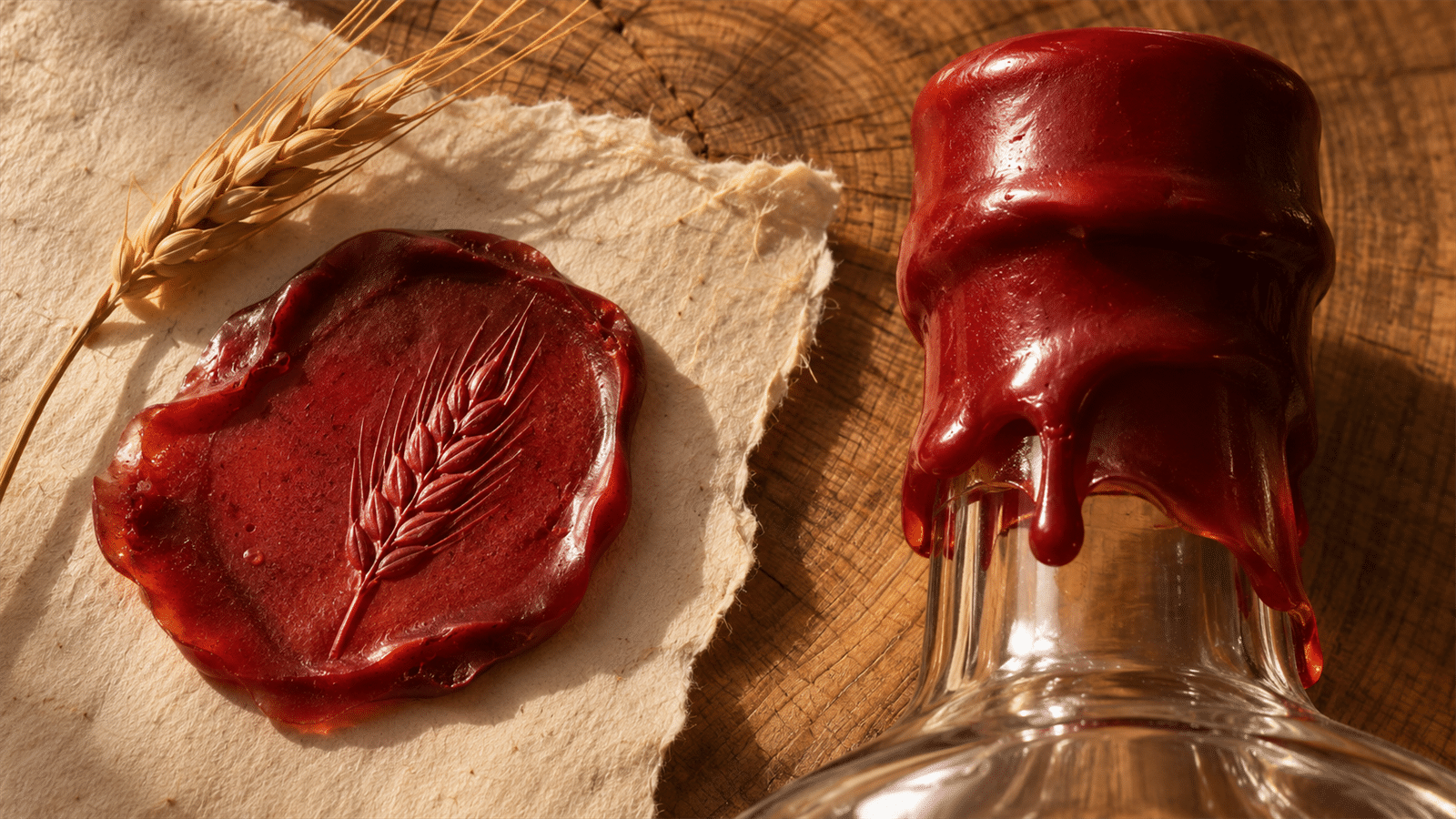
A visual refresh can give a brand more expressive range while preserving the cue that helps people recognize it. Maker’s Mark offers a concrete example: the red wax already associated with the bottle becomes a starting material for the wider identity. The useful decision for a brand director is what must remain recognizable before deciding what should look new.
Maker’s Mark announced its refreshed global identity on November 17, followed by Marketing Dive coverage on November 18. The work with Turner Duckworth London updates typography, imagery and the color palette around the wax. The bottle design remains unchanged, according to press materials cited by Marketing Dive. The announcement describes a rollout continuing through 2027; it supplies no measured sales or recognition uplift.
Find the asset that carries the memory
The brand’s own history credits Margie Samuels with its name, bottle design and signature wax. In the refresh, typography draws on her handwriting, while impressions of natural materials from Star Hill Farm connect the wax to a larger design vocabulary. The important strategic observation is continuity: the new identity develops an existing physical cue rather than introducing novelty without an anchor.
Other businesses should begin with an asset inventory, not copy the color or material. List the shapes, sounds, packaging details and recurring visual elements customers might associate with the brand. Separate what the team likes from what customers can actually identify. Internal familiarity is useful for finding candidates, but it cannot establish external recognition.
Test recognition separately from preference
Our suggested test starts with the commercial question: can a relevant buyer identify the brand when the logo or name is unavailable? Show a candidate cue in a realistic context and ask what brand it suggests. Record correct attribution, confusion with competitors and uncertainty. Evaluate aesthetic preference in a separate task so that a popular design does not automatically become a recognizable one.
This is an editorial recommendation, not a reported Maker’s Mark research method. Use samples and conditions appropriate to the business, and document their limitations. A small qualitative exercise can reveal confusion worth investigating, but it should not be presented as a population-wide recognition score. Compare the current and proposed versions under equivalent exposure conditions.
Translate the cue across real buying contexts
A physical material cannot simply be enlarged on every channel and assumed to work. Review the proposed identity on a small product image, a retail display, a social placement and the website. At each size, ask what remains visible, what requires explanatory copy and whether the product can still be found among alternatives.
For the design brief, define both constants and freedoms. A constant is the feature the team intends to preserve for recognition; freedoms are the elements that can vary by channel or market. This makes creative review more specific: a local adaptation can be judged against the asset’s intended job rather than against someone’s preference for one layout.
Budget the transition as well as the creative work
Before approval, list where the old identity lives, who replaces each item and when. Product imagery, retailer materials, paid creative and owned pages may have different replacement cycles. Decide how old and new executions can coexist without turning every difference into an emergency redesign. The announced multi-market rollout is a reminder to ask those operational questions, not evidence of how Maker’s Mark manages each one.
Track recognition and commercial outcomes as separate questions after launch. A sales movement can also reflect distribution, price, promotion or category demand. The lesson from this announcement is therefore a design principle with a testable hypothesis: preserve a credible recognition cue, give it useful expression across channels, and require evidence before claiming that the refresh created growth.
Sources
- Maker’s Mark: New global brand identity announcement
- Marketing Dive: Maker’s Mark visual refresh
- Maker’s Mark: Story of the brand and Margie Samuels