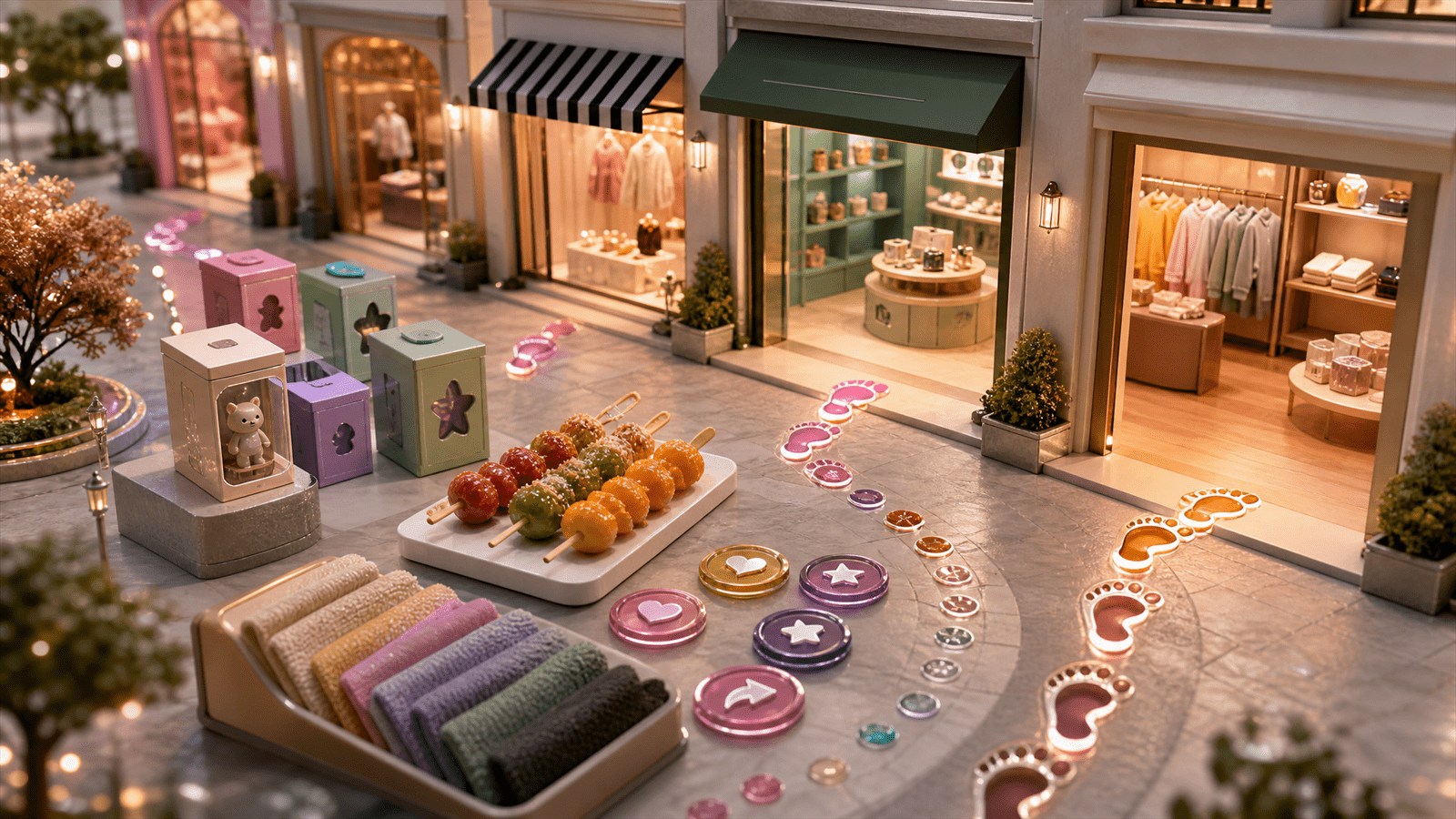
Mall of America’s latest retail mix is a useful case because it does not treat TikTok as only a media channel. Axios reported on September 8, 2026 that some of the mall’s buzziest additions were first discovered by shoppers on TikTok feeds, including Miniso, a claw-machine arcade, a tanghulu dessert stand and Roni’s, a mac-and-cheese bar with a large TikTok following.
The lesson is not that every mall should lease whatever is viral this week. The better lesson is that social discovery can become physical demand when the store gives people a reason to travel, buy, participate, film and return.
What Mall of America is testing
Axios described the shift as part of a move toward curated experiences and consumer engagement. The mall is not just filling space with recognizable retailers. It is adding brands and concepts that younger shoppers have already encountered online and may want to experience in person.
The demand signal is not only anecdotal. Axios cited Circana data showing that shoppers aged 18 to 24 made more than 60% of their general merchandise purchases in stores last year, compared with closer to 50% for older shoppers. That creates a useful tension for marketers: a younger audience may discover the idea on a feed but still want the social proof of a physical trip.
Why social discovery still needs a store
Digital attention is cheap to overstate. A video view, save or share does not prove that a shopper will cross town, wait in line or buy at a profitable price. Physical retail adds friction, but it also adds evidence. If a socially discovered brand can pull visits, create dwell time and help neighboring stores, the signal is stronger than a spike in reach.
Vogue Business, in a separate September 8 interview with Meta’s Eva Chen, described a similar shift in fashion: brands are moving from polished broadcast toward community, process and in-person moments that people document. For retail, that means the store is no longer only the conversion endpoint. It becomes the content set, sampling room, loyalty trigger and proof that the online signal was real.
A social-to-store scorecard
Demand quality. Is the online attention attached to a product, ritual or collectible behavior, or only to a joke? Brands built around repeatable product discovery are more likely to sustain visits than one-off memes.
Experience density. Does the store give visitors something to touch, taste, unbox, compare or photograph within the first minute? If the physical experience is thinner than the video, the visit may disappoint.
Audience fit. Does the concept bring the shoppers the property actually needs? A tenant can be noisy online but wrong for the catchment, price point or family trip mission.
Neighboring lift. Does traffic stay inside the tenant, or does it spill into adjacent categories? A mall cares about route design, dwell time and cross-shopping, not only the tenant’s queue.
Refresh cadence. Viral discovery decays. The operating model should include new drops, seasonal objects, collaborations, local creators and a plan for when the initial attention fades.
What to measure beyond foot traffic
Footfall is the first metric, not the final answer. Retail teams should also measure conversion rate, average transaction value, repeat visits, dwell time, store-to-social content volume, local search lift, email or loyalty capture, and whether the concept changes performance for nearby tenants.
Qualitative evidence matters too. Are visitors bringing friends? Are parents adding the destination to a trip because a child saw it online? Are customers filming the product experience without being prompted? Those are signals that the store is carrying the media effect rather than merely receiving it.
The lesson for retailers
The Mall of America case should push retailers to stop separating social strategy from real estate, merchandising and store operations. The question is not whether TikTok drives awareness. The harder question is which online signals deserve physical space and what evidence proves the lease or pop-up is working.
A strong social-to-store model starts before the opening. Score the demand, design the participation, tag the digital paths, measure the visit and refresh the experience. Viral attention can start the trip, but only a well-run physical experience turns that attention into retail economics.