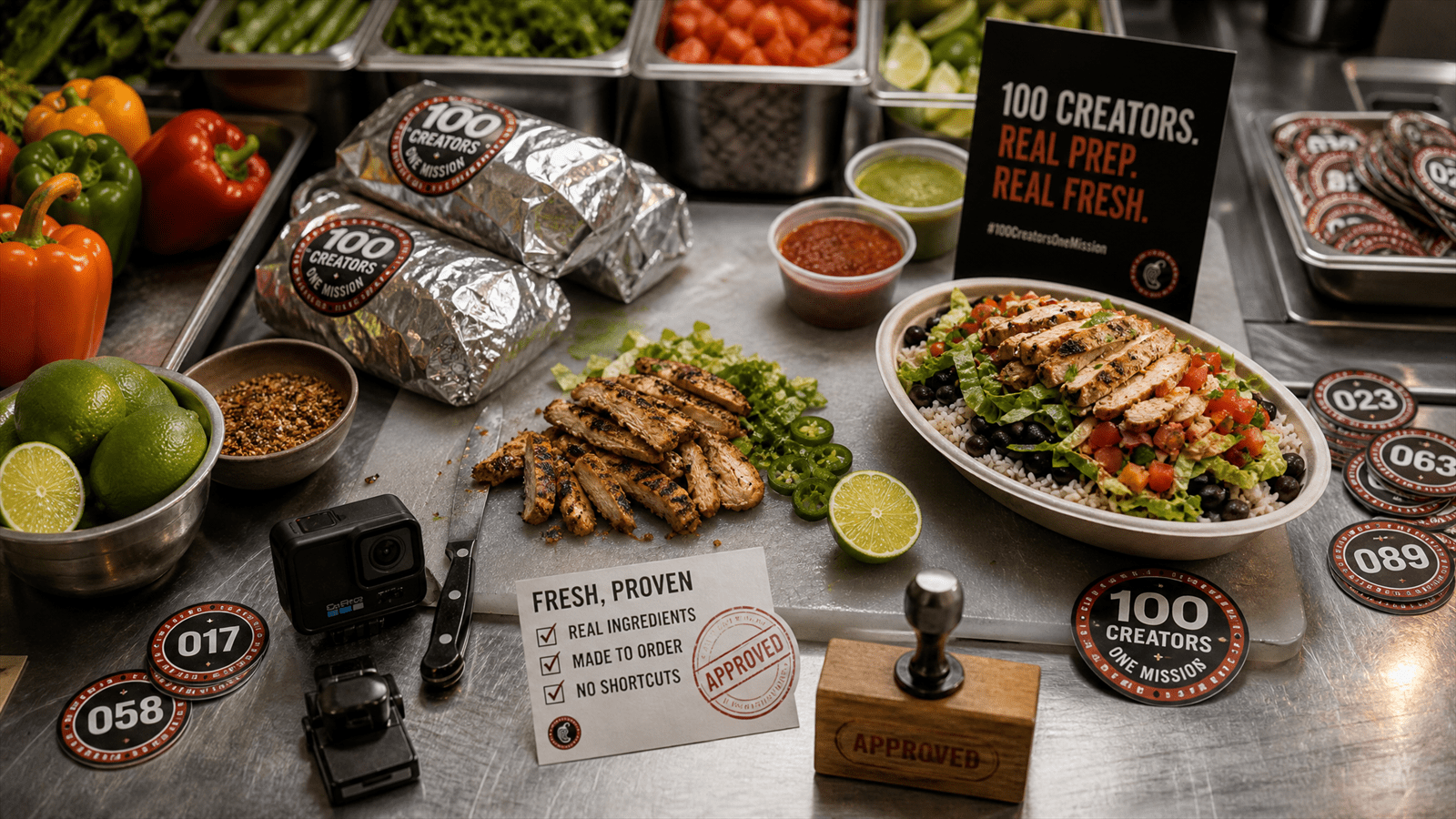
Chipotle’s latest creator campaign is more useful than the usual lesson of “work with influencers.” The company extended its Behind the Foil platform by bringing 100 creators into its kitchens to participate in preparation work for Pollo Asado and Chili Lime Chips. Marketing Dive reported that the collective social audience tops 100 million followers and that the campaign is the first national advertising push from Chief Brand Officer Fernando Machado.
The strategic point is not the size of the roster. It is the operating model. Chipotle is using creators to make a product claim feel observed rather than merely asserted. Freshness is hard to prove with polished brand footage because the more perfect the production looks, the more it can feel like advertising. A creator-led system can make the same claim more believable, but only if the brand defines the proof and boundaries before cameras enter the kitchen.
What Chipotle changed
The campaign swaps part of the brand-shot grammar for a montage of creator content. Instead of asking a single famous partner to endorse a menu item, Chipotle built a distributed set of creators around the same operational truth: what happens behind the foil before the customer sees the food.
That matters because restaurants and retailers often separate product operations from marketing. Operations creates the thing; marketing turns it into a claim. Chipotle’s approach narrows that gap. Preparation becomes the media asset, and the creators become witnesses to the product system.
Creator scale needs a product truth
Large creator programs fail when the only instruction is tone. A hundred people can generate a hundred unrelated interpretations. The stronger briefing model starts with a non-negotiable product truth. In this case, the visible preparation of food supports the freshness message. The creators can bring their own style, but they are all orbiting the same proof point.
That is the difference between authenticity and randomness. Authenticity is not the absence of control. It is the presence of enough real material that creators do not need to fake enthusiasm or invent claims. The brand should control what must be true, not every second of how it is expressed.
The creator briefing model
Retail marketers can borrow a five-part model. First, define the proof: what can the creator see, touch or test that makes the product claim credible? Second, define the boundary: food safety, claims, legal language, competitor references and editing rights. Third, choose variety deliberately. Non-food creators can help broaden reach, but they still need a reason to be in the story.
Fourth, plan rights and versioning before production starts. Creator footage may live in paid social, national ads, retail media, owned channels and PR. If rights are unclear, the best footage may be unusable. Fifth, decide how approval works. A campaign can give creators room without giving up factual accuracy.
What to measure beyond views
A social audience above 100 million is a distribution asset, not a result. The better measurement question is whether the campaign changes belief in the product claim. Track lift in freshness perception, menu-item awareness, search demand, app traffic, store visits where measurable, and creative holdout performance in paid media.
Also watch for message drift. If viewers remember the creators but not the food, the operating model is too loose. If every asset looks like a brand spot, the model is too controlled. The useful middle is recognizable product proof in many creator voices.
The lesson for retail marketers
Creator content works best when the brand gives creators access to something real. For restaurants, that can be preparation. For ecommerce brands, it can be product testing, sizing, unboxing, service recovery or category comparison. The assignment is not to “be authentic.” The assignment is to make the claim inspectable.
Chipotle’s campaign shows a practical trade-off: give up some production certainty to gain observed product proof. That trade-off only works when the brief is precise. If the product truth is strong, creators can make it travel. If it is weak, adding 100 voices only spreads the weakness faster.