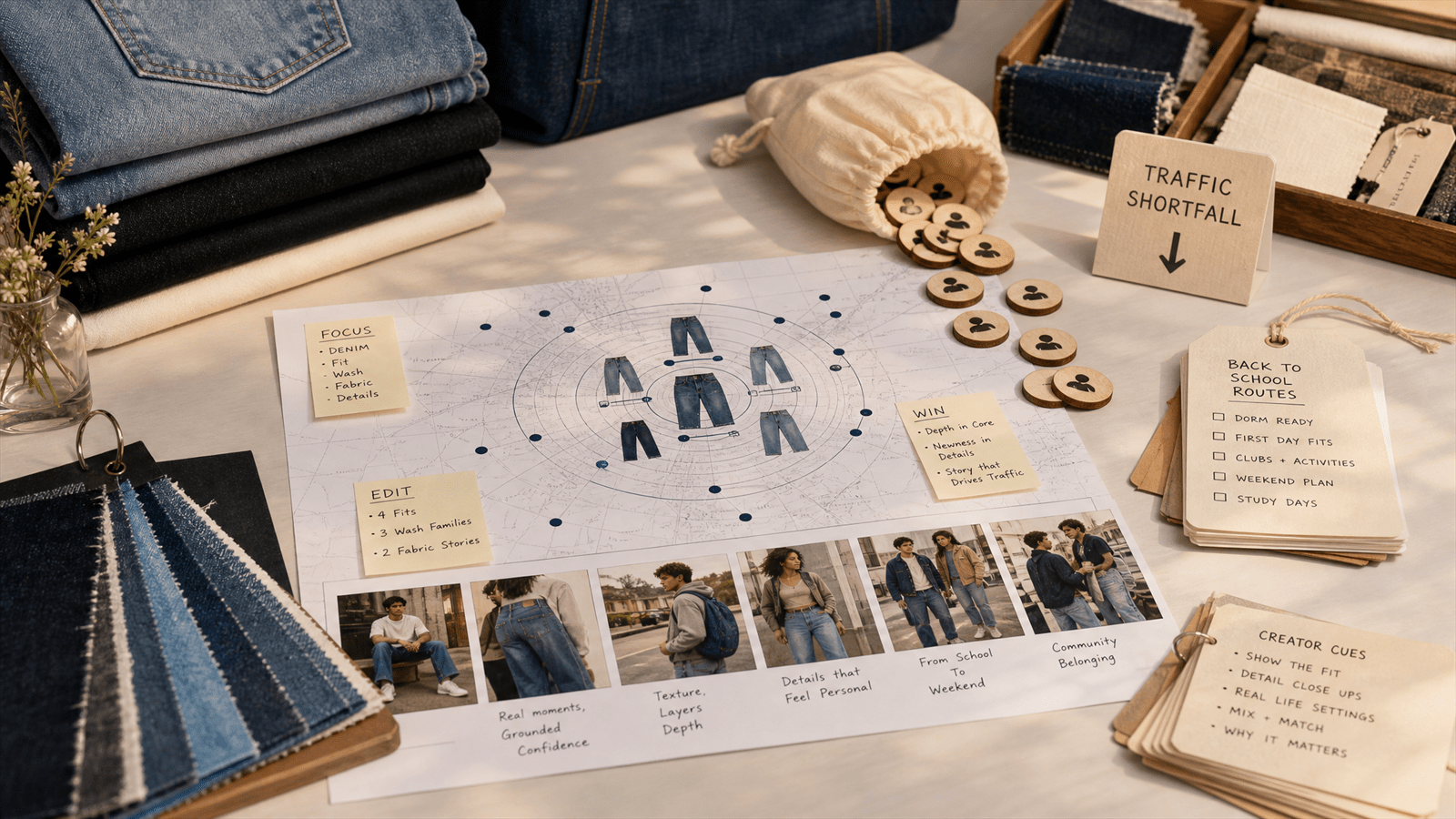
Old Navy’s latest marketing reset is useful because it ties creative news to a measurable business problem. Marketing Dive reported on August 28 that the brand is rewiring its marketing after a summer traffic shortfall. Gap Inc.’s Q2 release gives the pressure behind that language: Old Navy reported $2.1 billion in quarterly net sales, down 4% year over year, and comparable sales were also down 4%.
The brand is not responding with a vague awareness push. Management pointed to a stronger denim focus, a Cardi B-led “Most Wanted Denim” campaign, back-to-school activity and improved August traffic. That does not prove a turnaround yet, but it does show the shape of a practical retail response.
What Old Navy is trying to repair
A retail traffic miss can come from weak media, weak product, weak pricing, poor timing or a customer who no longer sees a reason to visit. Treating all of those as the same problem leads to generic campaigns. Old Navy’s response appears more disciplined: choose a destination category, make the creative culturally visible, and connect the message to immediate shopping occasions.
Gap Inc. also lowered its full-year comparable-sales expectation for Old Navy to flat to down 1%, while the Gap brand continued to show stronger momentum. That contrast matters. It suggests the issue is not only macro demand. It is also brand, category and execution.
Why denim is a turnaround category
Denim can carry a retailer because it is both practical and expressive. It has fit, wash, silhouette, price, styling and repeat-purchase logic. Old Navy’s campaign release emphasizes new and familiar silhouettes, broad fit language and value pricing, which gives the campaign product proof instead of relying only on celebrity attention.
For ecommerce and store teams, a destination category has another advantage: it creates a measurable path. The business can track campaign reach, search demand, product-page depth, store visits, category conversion, basket attachment and return behavior around a focused set of products.
The retail turnaround model
- Start with the miss: separate traffic, conversion, assortment, margin and pricing problems.
- Pick the category with the strongest right to win, not only the category with the largest media idea.
- Build creative around a customer occasion: school, work, weekend, family, travel or social identity.
- Connect creators and talent to product evidence, not just fame.
- Measure the category as a system: attention, visits, product depth, sell-through and repeat interest.
This model is stricter than a seasonal campaign calendar. It asks marketing and merchandising to share a diagnosis. If the product promise is weak, media cannot repair it. If the product is strong but invisible, creative and distribution need to work harder.
What to measure after the campaign
View counts are useful only as an early signal. A retailer needs to know whether attention became category demand. Track branded and category search, denim page visits, store-footfall changes, add-to-cart behavior, store availability checks, average unit retail, inventory movement and social comments that mention fit or value.
Also watch whether the campaign lifts only the hero product or the wider assortment. A destination category should create a path into the broader store. If shoppers come for denim but do not explore related items, the traffic plan is narrower than it appears.
The lesson for retailers
Old Navy’s case is not a formula that every retailer should copy. The lesson is the operating model: after a traffic miss, do not simply buy more reach. Define the commercial problem, choose a credible category, tie creative to the customer’s current occasion and review traffic quality quickly.
A turnaround campaign earns its budget when it changes behavior, not when it wins a moment of attention. Denim gives Old Navy a clear test. Other retailers need the same discipline around their own destination category.